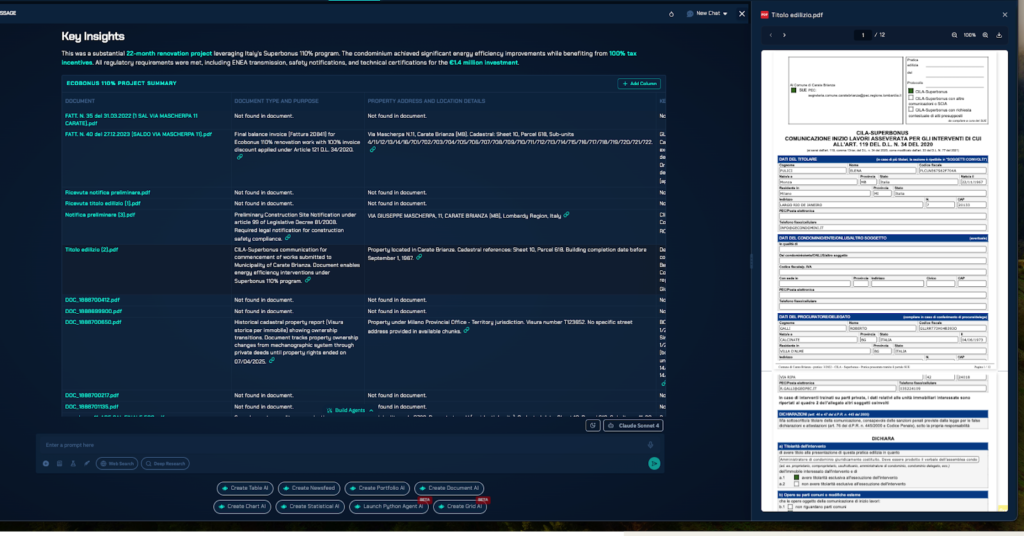
Artificial intelligence is rapidly transforming how financial professionals interact with information. Investment analysts, credit teams, and portfolio managers are increasingly relying on AI systems to analyze large volumes of documents, extract insights, and accelerate workflows that historically required significant manual effort.
Over the last two years, a new category of AI systems has emerged across financial markets: Grid AI (or Matrix AI).
One of the most prominent examples is Matrix, developed by Hebbia. The platform allows analysts to run structured queries across large document sets—extracting answers from PDFs, spreadsheets, presentations, and data rooms in parallel. Instead of a single query producing a single output, Matrix organizes results into a grid-like interface where rows represent documents and columns represent questions. This is now a standard available in Gemini, Perplexity, Alphasanse and others.
This represents a major shift from linear research → parallel analysis.
But what’s emerging now is the next layer:
interaction.
From Grid AI to Interactive Financial Workflows
Modern Grid AI systems are no longer just query engines.
They are evolving into interactive environments, where users can:
• drill into individual cells and validate outputs
• view source-backed citations tied to each answer
• chat directly with specific grid cells or document subsets
• share structured outputs across teams
• monitor datasets continuously with alerts and triggers
This introduces a new paradigm:
👉 Document AI + workflow interaction + inference
Instead of static outputs, AI becomes a living system—continuously updating, validating, and interacting with financial data.
This is especially important in finance, where workflows are not just analytical—they are operational and decision-driven.
The Missing Layer: Governance + Control
However, as financial institutions begin deploying these systems in production environments, a deeper challenge emerges.
The challenge is not analysis.
It is governance.
Financial institutions must be able to answer:
• Where did the data originate?
• Who accessed it?
• What policies governed its use?
• Can outputs be audited and reproduced?
Without this layer, even the most advanced Grid AI systems remain research tools—not institutional systems.
From Grid AI to Inference-Driven Financial Systems (Scalata.ai)
This is where Scalata.ai introduces the next evolution.
Scalata has released one of the most advanced Document Grid AI platforms, built on agentic, inference-driven AI systems.
Instead of stopping at document querying, Scalata extends Grid AI into end-to-end financial workflows.
This includes:
1. Document AI + Structured Grid Intelligence
Unstructured financial documents are transformed into structured, queryable grids—similar to Matrix—but integrated into broader workflows.
2. Interactive Grid Controls (Widgets)
Each grid becomes an interactive system:
• shareable across teams
• chat-enabled at the cell level
• source-linked with full citation traceability
• continuously monitored with alerts and triggers
This transforms the grid from a static interface into a collaborative decision system.
3. Agentic Workflow Execution
AI agents operate across workflows—moving from data ingestion → analysis → reporting → monitoring.
This enables:
• continuous portfolio tracking
• automated credit analysis
• real-time risk monitoring
4. Governance + Compliance Infrastructure
Scalata integrates:
• policy-based guardrails
• data lineage tracking
• role-based access controls
• governed data marketplace integration
This ensures that every AI output is:
✔ traceable
✔ auditable
✔ compliant
Why This Matters
Matrix-style Grid AI has redefined how financial research is performed.
But the next phase of financial AI will not be defined by how well systems analyze documents.
It will be defined by:
• how they integrate into workflows
• how they enable interaction and monitoring
• how they enforce governance and control
In other words:
👉 The future is not just Grid AI
👉 It is governed, agentic, inference-driven financial systems
And that is the layer Scalata.ai is building.