
Grid AI, Python Agent and Multi Tabs sheets financial models, Banking Partnerships & the Road to Full Personalised Agentic AI
Q1 2026 marks a transformative quarter for Scalata.ai — one defined by the launch of Grid AI, our Python Agent to code inside Multi Tab sheets, additional canvas modelling deepening enterprise banking partnerships, a Beta version of a Compliance Framework with Policies and Guardrails and an accelerating trajectory toward fully personalised agentic AI for a fully comprehensive financial framework.
A Message from Our Team
This first quarter of 2026, Scalata.ai has continued to push the boundaries of agentic AI in regulated financial markets. Building on the momentum of our award-winning platform — recognised at The Digital Banker’s Global Banktech Awards 2025 as the ‘Best Gen-AI Financial Markets Solution by a Vendor’ — we have entered Q1 2026 with significant platform milestones and expanded strategic presence.
This quarter, we launched the Beta release of Grid AI, Python Agent, and Multi-Tab Tables developments with powerful Python app development— our groundbreaking reasoning layer that orchestrates complex multi-agent workflows with full transparency and traceable outputs. We have also deepened our partnerships with major banking institutions, expanded our presence at industry events, including the MISMO Winter Summit 2026, and continued onboarding enterprise clients across the US, EU, Japan, and Brazil. Our platform evolution has accelerated with the introduction of Python Agent Beta, Remittance Report Generation, enhanced Table AI, and next-generation LLM integrations that bring improved reasoning and lower latency to every agentic workflow.
🚀 Market Traction & Client Success
Our annual recurring revenue (ARR) has grown to $5000K, with an active pipeline of approximately $1.2 million in deals under negotiation. Scalata.ai has generated over 30 new opportunities across three continents, with major enterprise deployments progressing in the US and EU, and active expansion into Japan and Brazil. Our SOC 2 Type II compliance certification continues to serve as a critical differentiator in enterprise procurement processes, enabling accelerated client onboarding with tier-1 financial institutions that require independently verified security and governance controls.
💼 Strategic Growth: Fundraising and Partnerships
- Deepened our strategic partnership with the MISMO community for mortgage lending in the USA, actively participating in both the MISMO Marketplace and Built on Program — reinforcing Scalata’s role in setting agentic AI standards for the mortgage data ecosystem.
- Progressed partnership discussions with a major global banking institution — one of the largest players in finance, AI and total banking solutions — marking a pivotal step toward enterprise-scale deployment of Scalata’s agentic credit platform within tier-1 banking infrastructure.
- Attended a major Japan conference focused on Nasdaq-listed markets and capital market innovation — opening new commercial frontiers in Asia and establishing Scalata’s presence as a global leader in compliance-first agentic AI for financial institutions.
🏢 Team Growth
- Welcomed a new Head of Sales in the USA, bringing deep expertise in fintech enterprise sales, coming from IBM and Bloomberg.
- Added a Junior Customer Success Specialist to strengthen client support and accelerate onboarding for our growing roster of enterprise clients.
- Added two Senior Software Engineers to accelerate platform development
- Actively recruiting for an additional Sales Director and two Senior Software Engineers to accelerate platform development and expand our commercial reach ahead of key Q2 2026 events.
Throughout Q4, we published a series of deep-dive articles exploring how agentic AI, generative data infrastructure, and compliance-first design are reshaping credit, lending, and capital markets.
Grid AI: Bringing Transparent Multi-Agent Reasoning to Financial Decision-Making
- Financial institutions require more than automation — they need explainable, auditable AI that reveals the “why” behind every decision — especially in credit, risk, and compliance workflows.
- Scalata’s Grid AI is a matrix-style reasoning layer that orchestrates multiple specialised agents, delivering fully traceable outputs across complex financial workflows — from loan analysis to structured credit reporting.
- By making the reasoning process transparent at every step, Grid AI empowers analysts and compliance teams to validate AI-generated insights with confidence — without sacrificing speed or operational agility.
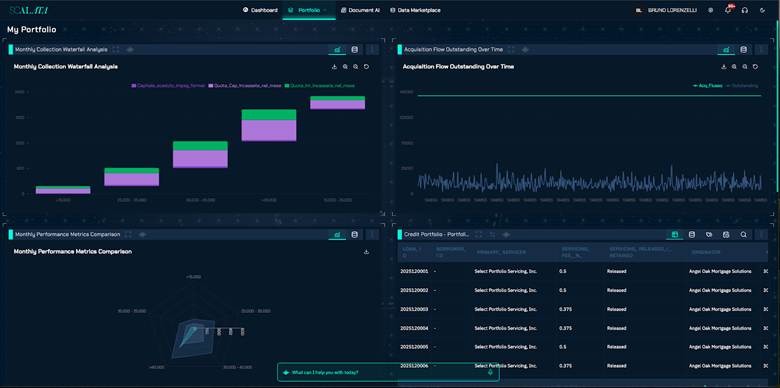
From Python Agents to Remittance Automation: Expanding the Agentic Frontier
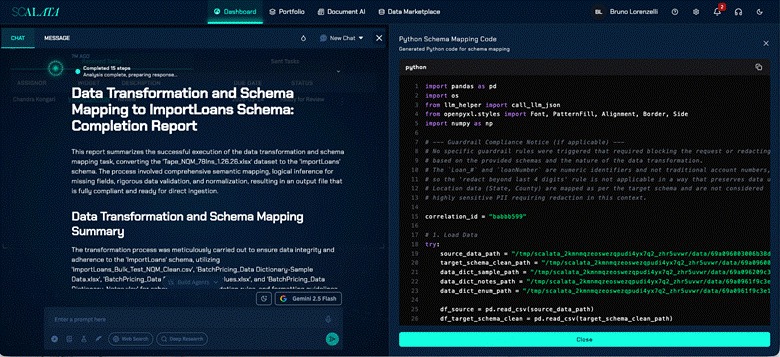
Q1 2026 introduced the Python Agent Beta — enabling users to execute custom scripts, build workflows, and perform advanced data manipulations directly within the Scalata platform. Unlike general-purpose AI tools such as Claude or other market solutions, Scalata operates within structured, governed workflows—allowing users to execute tasks, build reusable widgets, and validate outputs in real time within a controlled environment.
A new Remittance Report Generation capability synthesises remittance data from both structured and unstructured sources, streamlining reconciliation processes that previously required significant manual oversight and specialist expertise.
Enhanced Table AI now delivers optimised data processing and automated schema mapping — drastically accelerating the ingestion and normalisation of large, complex financial datasets across asset classes.
Remittance Report Automation in Practice
Remittance reporting remains one of the most manual and error-prone workflows in servicing, securitisation, and structured finance—requiring teams to aggregate data across multiple systems, reconcile discrepancies, and produce investor-ready reports under tight timelines.
Scalata’s Remittance Report capability automates this entire process end-to-end. Using natural language prompts, teams can generate fully reconciled, formula-driven Excel workbooks in minutes—eliminating manual aggregation while ensuring accuracy, auditability, and consistency across reporting cycles.
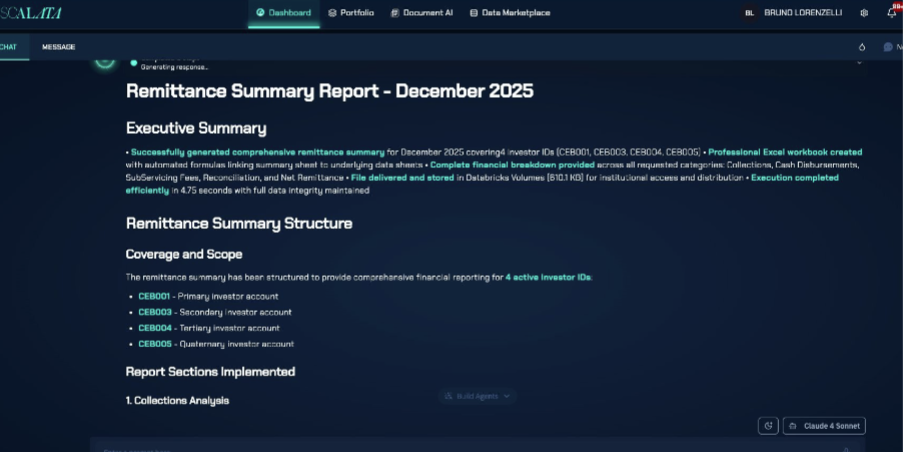
Screenshot — AI displays the complete Data Sources Mapping plan with section-by-section field mapping
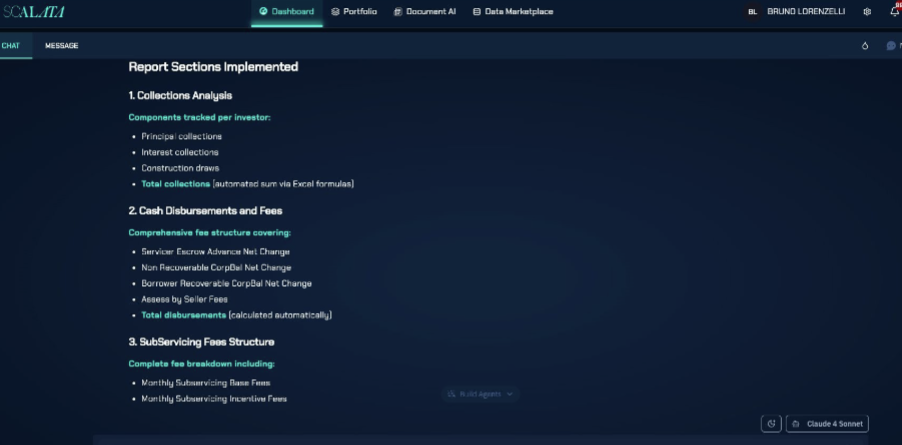
Screenshot — Collections, Cash Disbursements, and SubServicing Fees mapping is fully detailed
Key capabilities include:
- Workflow-native AI execution — Build, run, and validate reporting workflows (not just generate outputs)
- Natural language report generation — Define report structure (collections, disbursements, fees, reconciliation, net remittance) in plain English
- Automated data mapping & validation — AI identifies and surfaces source mappings for user confirmation before execution
- Multi-tab, formula-driven outputs — Generates professional Excel workbooks with linked sheets and dynamic calculations
- Full auditability & traceability — Every output is backed by visible data lineage, formulas, and reproducible logic
- Integrated validation layer — Users can inspect, verify, and audit results directly within the platform before distribution
By moving remittance reporting from fragmented manual workflows to structured, agentic execution, Scalata enables financial institutions to scale operations while meeting the growing demands for transparency, governance, and speed.
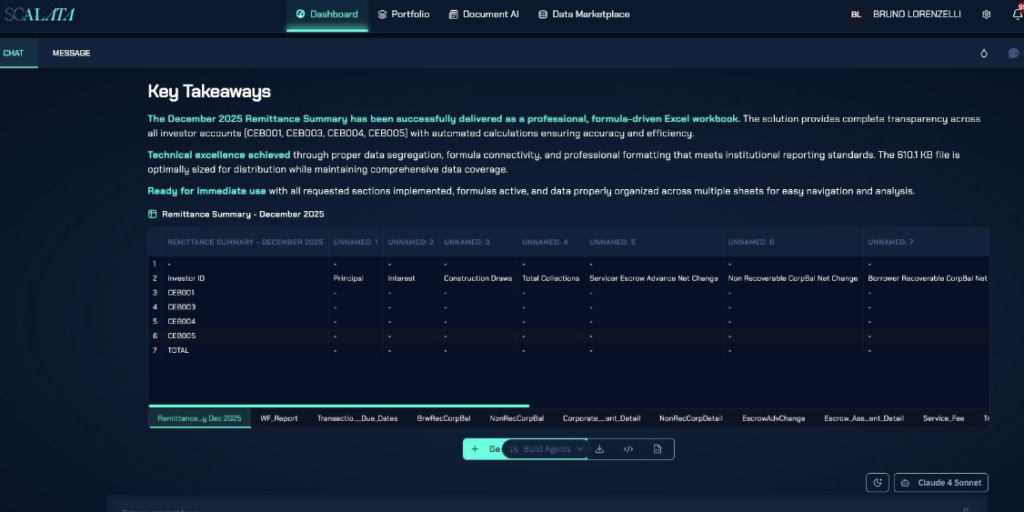
Screenshot — User clicks Confirm & Proceed; AI begins Python execution with thinking visible
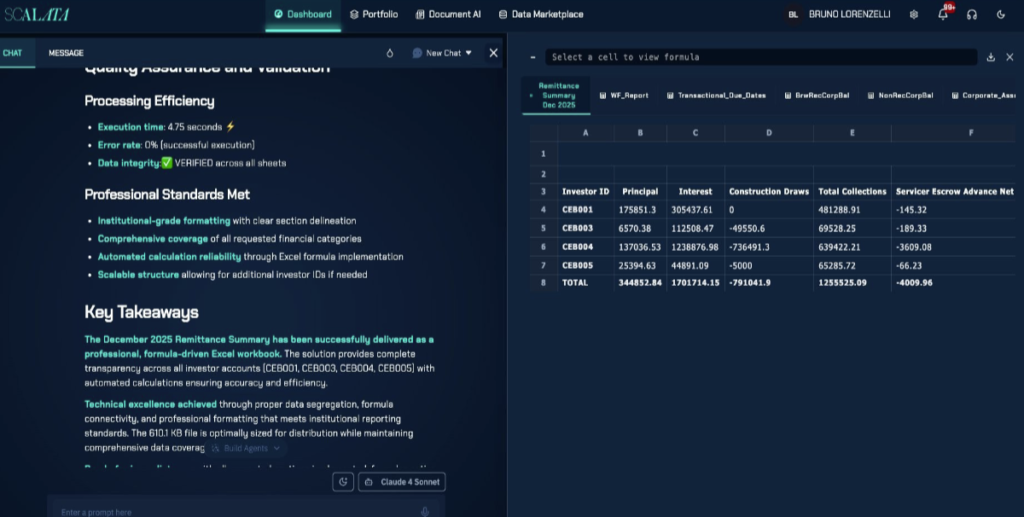
Screenshot — Live Python execution visible in the code panel; imports and sheet-loading functions shown
Governance at Scale: The Policy & Guardrail Engine Powering Enterprise AI
- Enterprise AI adoption in regulated finance is no longer slowed by capability gaps — it’s slowed by governance gaps. Institutions need AI systems that are compliant by design, not by retrofit.
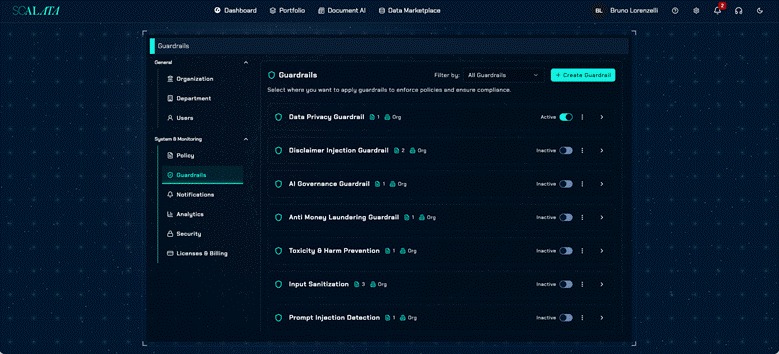
- Scalata’s new Gen AI-supported Policy & Guardrail Engine acts as a real-time compliance backbone — ensuring every agentic workflow adheres to enterprise-grade security protocols, regulatory requirements, and institutional-specific policy rules.
- Integrated with quota management, audit trail systems, and customisable governance frameworks, the engine gives compliance officers and CIOs full visibility and control over every AI action taken within the platform.
Agentic AI in the Age of Regulation: How Financial Institutions Are Operationalizing AI Safely
- With the EU AI Act entering phased enforcement and US regulators applying SR 11-7 model risk principles to AI, financial institutions face a clear mandate: AI governance is no longer optional — it is a procurement requirement.
- Scalata is built from the ground up for regulated environments — embedding SOC 2 Type II controls, transparent data lineage, and human-in-the-loop oversight directly into agentic workflows — so institutions never have to choose between speed and compliance.
- As multi-jurisdictional regulatory standards converge, platforms that reduce regulatory friction while accelerating operational workflows — like Scalata — will define the next phase of enterprise AI operationalisation in finance.
Technical Achievements – Q1 2026
Platform Evolution
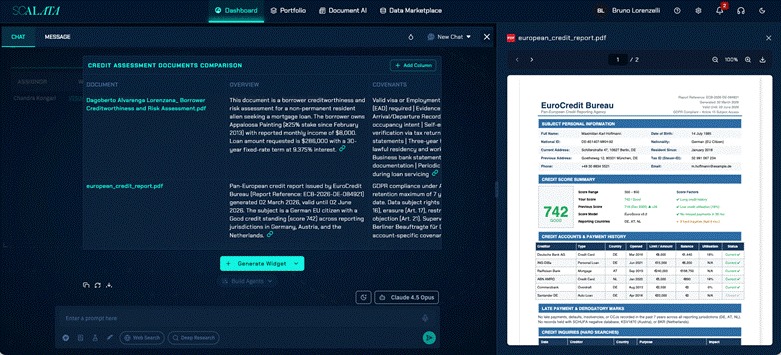
Q1 2026 marks a transformative shift with the Beta release of Grid AI, the groundbreaking reasoning layer first teased in our Q4 roadmap. Grid AI serves as a sophisticated matrix-style interface that orchestrates complex workflows across multiple agents with absolute transparency, providing fully traceable outputs that explain the “why” behind the “what” for high-stakes financial decision-making.
Agentic Expansion & Advanced Reporting
We have significantly broadened our agentic ecosystem to handle more technical and specialized financial workflows. The Python Agent has entered a formal Beta release, allowing users to execute custom scripts and advanced data manipulations directly within the platform. A new Remittance Report Generation capability synthesizes remittance data from both structured and unstructured sources, streamlining reconciliation processes that previously required manual oversight. Our core data processing engines also received a major upgrade with enhanced Table AI, now featuring optimized data processing and automated schema mapping for faster, more accurate handling of large financial datasets.
Data Marketplace & Model Integration
The Scalata.ai ecosystem continues to grow with the integration of the newest generation of Large Language Models, allowing agents to leverage improved reasoning and lower latency for complex queries. Building on our existing integrations with Google Drive, OneDrive, and Snowflake, we have added new real-time data connectors to ensure a more comprehensive data fabric across the platform.
Enterprise Governance & Security
Security is the cornerstone of our enterprise offering. This quarter, we implemented Gen AI–supported Policy & Guardrail Engines that now serve as the security backbone of the Scalata.ai platform, ensuring all agentic workflows adhere to strict enterprise-grade compliance and security protocols in real-time. These updates work in tandem with our quota management and audit trail systems to provide a fully customizable governance framework.
Looking Ahead
As we move into Q2 2026, Scalata.ai will focus on further refining the Financial Product Creation Widget as it nears full production release. We will also introduce deeper cross-platform synchronization and expanded predictive analytics capabilities to further empower our global user base.
Events, Podcasts & Thought Leadership
This quarter, Scalata.ai expanded its global presence across finance, AI, and regulatory conversations through podcast appearances and industry engagements focused on real-world deployment of agentic AI in regulated environments.
Podcasts & Media
Scalata strengthened its thought-leadership footprint through new episodes in our Shaping FinGenAI series and guest appearances across industry platforms:
- Redefining Finance: Building Trust, Compliance, and Innovation with AI — The Scalata Journey
Explores Scalata’s founding vision and how compliant AI can operate safely within regulated financial environments. - AI Infrastructure vs. Hype: The $1 Trillion Misconception
Challenges the narrative that AI success is driven primarily by infrastructure spending rather than workflow intelligence. - The Future of Finance in the Age of AI
Examines how AI is transforming credit, risk management, and capital markets — while highlighting the enduring role of human judgment. - Scalata CEO Bruno Lorenzelli also appeared on MISMO Mic’d Up — Episode 5: From Tape Cracking to Agentic AI, discussing the evolution of mortgage data standards and the emergence of agent-driven workflows.

Industry Engagement & Events
- MISMO Winter Summit 2026
Scalata engaged with industry leaders on mortgage data modernization, standards evolution, and the role of AI-driven workflows in enabling interoperability across lending ecosystems. - Summit Highlights
Key discussions focused on accelerating digital transformation in mortgage operations through standardized data, automation, and compliance-ready AI systems.

Navigating the Evolving Landscape
Q1 2026 Market & Regulatory Intelligence Brief
Over the past three months, global regulatory bodies, central banks, and financial authorities have intensified their focus on AI governance, operational resilience, and systemic risk. The conversation has shifted decisively from experimentation to supervision.
At the same time, the competitive landscape is rapidly evolving toward agentic, workflow-driven AI systems:
- Anthropic has introduced Claude Cowork, plugins, and enterprise connectors—allowing AI to integrate directly into tools like Slack, Google Workspace, and financial data systems, and execute multi-step workflows rather than just respond to prompts (MLQ AI)
- Their plugin ecosystem enables teams to package workflows into reusable “AI specialists,” combining connectors, commands, and domain-specific logic to standardize how work gets done across functions like finance, legal, and operations (Generation Digital)
- New releases also show Claude moving toward computer-level task execution, where the system can operate applications, browse files, and complete tasks autonomously with user permission (The Verge)
- Perplexity AI is pushing similar boundaries with computer-use AI agents, expanding from search into systems that can take actions across tools and environments rather than just return answers (Forbes).
- Hebbia’s Matrix platform has defined the Grid AI category—enabling analysts to run structured queries across large document sets in parallel, shifting workflows from linear research to matrix-style analysis (Business Insider).
These platforms mark a clear transition:
Chat → Search → Agents → Workflow Systems
However, most remain focused on interaction and analysis layers.
Regulated industries are now demanding something more:
execution, validation, and governance inside the workflow itself.
1. EU AI Act: Implementation Phase & Financial Services Implications
What’s Happening
The EU AI Act has entered phased implementation, with high-risk AI obligations for financial services moving toward 2026 enforcement.
Supervisory guidance across EU member states has begun clarifying expectations around credit scoring, underwriting, AML, and algorithmic risk tools.
Alignment discussions are underway between AI Act requirements and DORA (Digital Operational Resilience Act), particularly around monitoring, incident reporting, and third-party AI vendors.
Key Regulatory Themes
- Mandatory transparency for AI systems influencing financial decisions
- Model documentation and auditability requirements
- Human oversight frameworks for automated decision systems
- Clear risk classification and governance structures
Market Signal
European financial institutions are accelerating vendor due diligence and prioritizing platforms with embedded governance, rather than bolt-on compliance layers.
2. US Regulatory Oversight: Risk Management Over Restriction
What’s Happening
US regulators continue embedding AI into existing model risk frameworks (SR 11-7), emphasizing explainability, bias testing, and operational resilience.
Key Regulatory Themes
- AI as an extension of model risk management
- Stress-testing of AI outputs
- Vendor transparency and documentation
- Board-level oversight
Market Signal
Institutions are prioritizing AI systems that integrate directly into existing audit and governance structures.
3. Global Convergence on AI Governance Standards
What’s Happening
G7, OECD, and global regulators are converging around risk-based AI regulation, with expanded regulatory sandboxes in Asia and increased focus on systemic risk.
Key Regulatory Themes
- Cross-border compliance consistency
- Explainability in high-risk use cases
- Monitoring AI-driven financial decisions
- Responsible deployment standards
Market Signal
Global institutions are seeking multi-jurisdictional, compliance-ready AI platforms.
4. Enterprise AI Market Trends: From Infrastructure to Workflow Intelligence
What’s Happening
While infrastructure investment continues, enterprise buyers are shifting toward workflow-level ROI.
Platforms like Claude, Perplexity, and Hebbia demonstrate strong capabilities in:
- document analysis
- search and reasoning
- agent-based interaction
But real-world deployment reveals a gap:
interaction ≠ execution
Key Market Themes
- Demand for agentic AI embedded into real workflows (credit, lending, reporting)
- Shift from copilots → multi-agent orchestration
- Procurement focuses on auditability, lineage, and governance
- Need for validation layers, not just generation
Market Signal
The market is moving from AI experimentation → AI operationalization.
5. What This Means for Scalata.ai
Across markets, three priorities are now clear:
- Compliance-first architecture is mandatory
- Explainability and auditability are non-negotiable
- Workflow-native AI outperforms general-purpose tools
While platforms like Anthropic, Perplexity AI, and Hebbia are advancing interaction and agent layers, the next phase of enterprise adoption will be defined by systems that:
- Execute tasks within workflows
- Validate outputs before delivery
- Enforce governance in real time
- Operate within regulated environments
As AI becomes embedded into core banking, credit, and capital markets infrastructure, platforms that combine workflow execution + validation + compliance will define the next generation of financial technology.
Looking Ahead: Q1 and Beyond
As we move to Q2 2026, our priorities include:
- Scaling pilot deployments with enterprise banking and credit clients, converting active pipeline into signed agreements across the US, EU, Japan, and Brazil
- Advancing Grid AI from Beta to full production release, incorporating user feedback from early enterprise adopters to refine the multi-agent reasoning interface
- Completing the migration away from Databricks to our proprietary Agentic AI Datalake technology — delivering greater performance, cost efficiency, and data sovereignty for enterprise clients
- Launching the Financial Product Creation Widget into full production and expanding predictive analytics capabilities, while continuing to deepen commercial presence across Brazil and Japan ahead of major regional events[7]
Upcoming Industry Events — Q2/Q3 2026
- Money 20/20 USA — October 2026, Las Vegas, NV. The flagship global fintech event where Scalata will showcase its latest agentic AI capabilities to banks, lenders, and technology partners.
- ABS East — Miami, FL. The premier securitisation conference in the Eastern US, where Scalata will meet with issuers, investors, and servicers exploring agentic AI for structured product analytics and reporting.
Experience Scalata.ai
Ready to see how Scalata.ai can transform your credit analysis workflow? Our platform offers:
● Cutting-edge AI analysis capabilities
● Seamless integration with existing systems
● Industry-leading security and compliance
● Dedicated support team
Book a demo with our team today to experience the future of credit analysis.
Scalata.ai is committed to maintaining the highest standards of data security and regulatory compliance, including active pursuit of SOC2 certification and alignment with evolving AI regulations. Our platform is designed to meet the stringent requirements of financial institutions while pushing the boundaries of what’s possible in credit analysis.
For more information about our products or to schedule a meeting, please contact our team at info@scalata.ai
Scalata.ai, 295 Madison Avenue, New York, NY 10017
