
Over the past two years, financial research has undergone a structural shift.
AI platforms like Hebbia (Matrix), AlphaSense, Perplexity AI, and Google Gemini have introduced a new paradigm: 👉 parallelized intelligence.
Instead of reading documents sequentially, analysts can now:
- query entire datasets at once
- extract structured answers across hundreds of files
- generate summaries instantly
This has fundamentally redefined research workflows.
But something important is happening: 👉 these platforms are starting to converge.
Where the Market Is Converging
Across tools, we now see similar capabilities emerging:
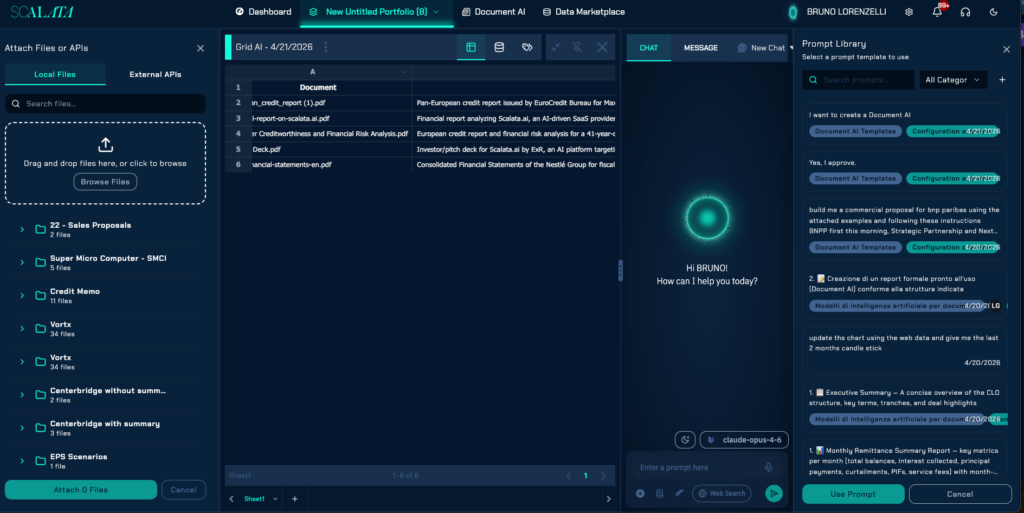
1. Parallel Document Querying (Grid / Matrix Interfaces) Hebbia’s Matrix pioneered it. Others are replicating it. The pattern is familiar: upload a set of documents, define the columns of data you want extracted, and let the system populate the grid.
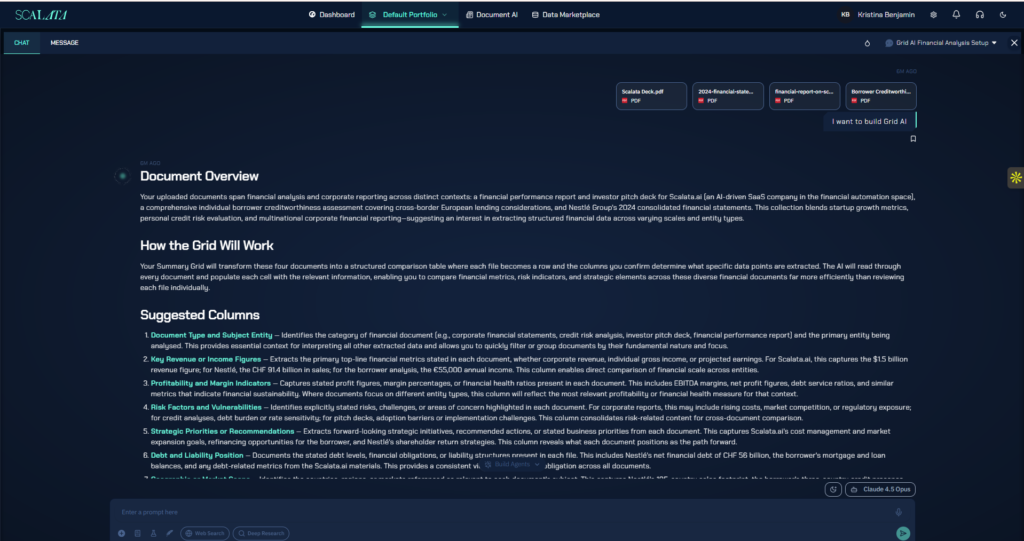
Show Image Grid AI in Scalata: uploaded documents become rows, extraction targets become columns — the now-standard paradigm across research platforms.
2. Generative Summaries + Citations AlphaSense, Gemini, and Perplexity all now provide source-backed answers.
3. Conversational Interfaces Chat is becoming standard across every platform.
4. Sequenced Research + Content Building This is the newest frontier. Perplexity Computer, launched in early 2026, explicitly positions itself as a system that “reasons, delegates, searches, builds, remembers, codes, and delivers.” You describe an outcome; it decomposes the goal into subtasks, spins up sub-agents, runs them in parallel, and assembles a finished deliverable. This is a meaningful leap — from answering questions to sequencing entire research-to-output workflows.
The Problem: Research Is Not the End State
Despite rapid innovation — including sequenced agentic systems like Perplexity Computer — these platforms are still primarily: 👉 research acceleration tools
They help answer questions faster. They even help draft deliverables faster.
But financial institutions don’t just need answers or deliverables.
They need:
- repeatable workflows
- controlled processes
- operational execution
- system-level accountability
- concurrent, permissioned operations across teams
This is where most platforms stop.
Where Platforms Begin to Break Down
As firms try to operationalize these tools, limitations emerge:
Fragmentation Outputs exist in isolated sessions — not integrated workflows.
Lack of persistence Insights are not continuously monitored or updated.
No true execution layer inside institutional systems Even Perplexity Computer — arguably the most advanced sequenced agent on the market — operates as a general-purpose productivity layer. It generates deliverables beautifully, but it does not plug into a bank’s credit monitoring system, a fund’s covenant tracker, or a lender’s remittance pipeline with institutional controls.
Limited governance depth Basic citations exist — but not full auditability, policy enforcement, role-based access, or redaction controls on shared outputs.
Single-thread interaction models Most tools — even agentic ones — run one primary task or conversation at a time per user. Finance operations don’t work that way. A credit team runs covenant checks, portfolio monitoring, remittance reconciliation, and counterparty reporting simultaneously.
The Next Battlefield: From Intelligence → Systems
The next phase of competition is no longer about: who has the best answers.
It’s about: 👉 who can build systems that act on those answers — concurrently, continuously, and under institutional control.
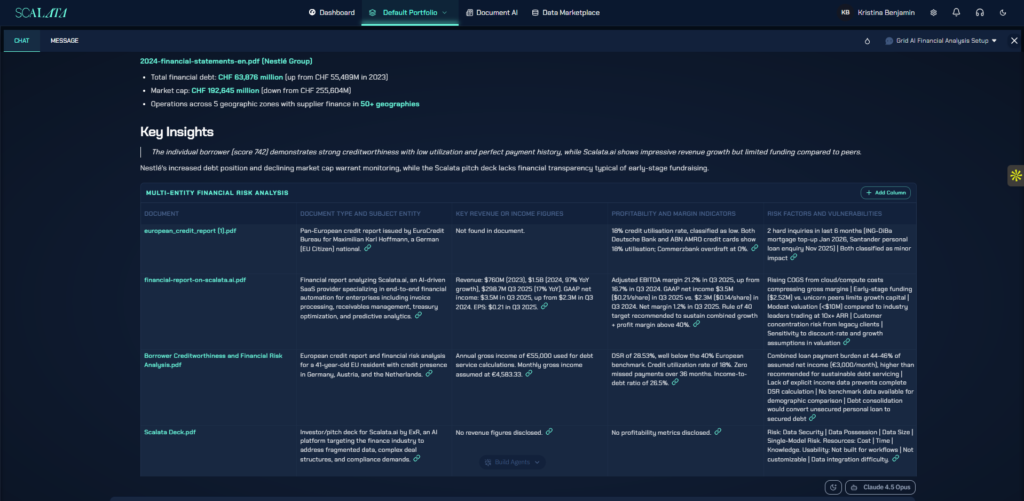
Grid outputs are only the beginning. The question is what happens next — do the cells sit as static analysis, or do they feed into live institutional systems?
Scalata.ai: Moving Beyond the Research Layer
Scalata approaches this differently.
Instead of treating Grid AI as a product, it treats it as: 👉 a component inside a larger financial system.
And instead of treating sequenced research — the Perplexity Computer paradigm — as the destination, it treats it as the baseline for what a financial AI system must do.
Key differences:
1. Persistent, Living Systems Grids are not static outputs — they are continuously monitored environments.
2. Workflow Integration Outputs directly feed:
- credit models
- reporting pipelines
- risk monitoring systems
3. Sequenced Agentic Execution — With Concurrent Control Perplexity Computer has shown the market what goal-driven task decomposition looks like. Scalata already operates on this principle for finance — and extends it in two ways that matter for institutions:
- Unique code generation and widget sequence technology — Scalata generates purpose-built code and interactive widgets on the fly for each step of a financial workflow (covenant check → exposure calc → memo draft → dashboard → alert). The deliverable isn’t a PDF; it’s a live, reusable component inside the workflow.
- Concurrent multi-chatbot orchestration — Scalata runs multiple chatbots and agentic tasks in parallel, each with precise control over the content it produces, the data it can touch, and the users it can respond to. One agent monitors covenants. Another reconciles remittance. A third drafts credit memos. A fourth answers analyst queries. All operating at the same time, coordinated — not colliding.
This is where general-purpose sequenced agents stop and finance-native systems begin.
4. Compliance AI: Policies, Guardrails, and Institutional Control
Beyond workflow automation, Scalata introduces a dedicated Compliance AI layer — designed for regulated financial environments where governance is not optional.
This layer embeds policy enforcement directly into how data is accessed, analyzed, and shared.
Key capabilities include:
- Policy-based guardrails that control how AI can interact with sensitive financial data
- Role-based access enforcement across teams
- Real-time validation checks on outputs before they’re used in decision-making or reporting
- Audit trails and reproducibility
- Data lineage tracking, linking every answer back to its original source
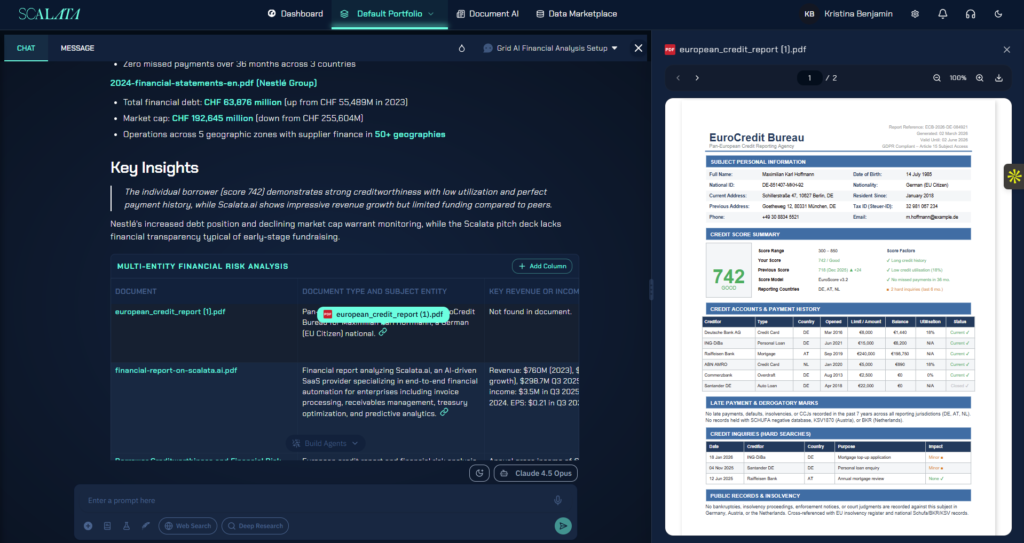
Every cell in a Scalata grid links directly back to its source document — data lineage is built into the interaction, not bolted on.
Instead of treating compliance as a downstream review process, Scalata integrates it directly into the AI workflow itself.
This creates a fundamental shift: 👉 AI systems are no longer just analytical tools 👉 They become policy-aware, institution-ready infrastructure
Why This Shift Matters
The market is moving from: 👉 tools → platforms → systems
And the winners will not be defined by: who analyzes documents best or even: who sequences research best
but by: 👉 who embeds concurrent, controlled, compliant AI into core financial operations.
Final Thought
Grid AI made research faster. Perplexity Computer made sequenced deliverables possible.
But financial institutions don’t scale on speed or sequences alone.
They scale on:
- control
- repeatability
- execution
- concurrency under policy
👉 The next generation of AI platforms will not just answer questions or generate reports. 👉 They will run the system — many workflows at once, under institutional control.
And that is the layer Scalata.ai is building.
