
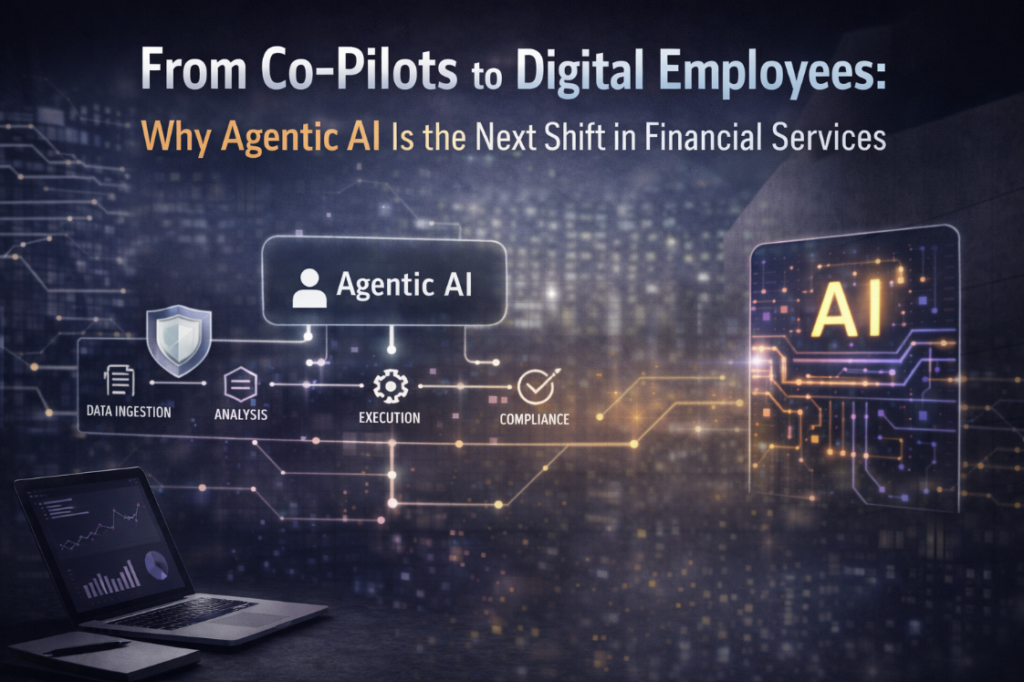
For years, AI in finance has been positioned as a: 👉 co-pilot
Tools that:
- assist analysts
- accelerate research
- generate insights
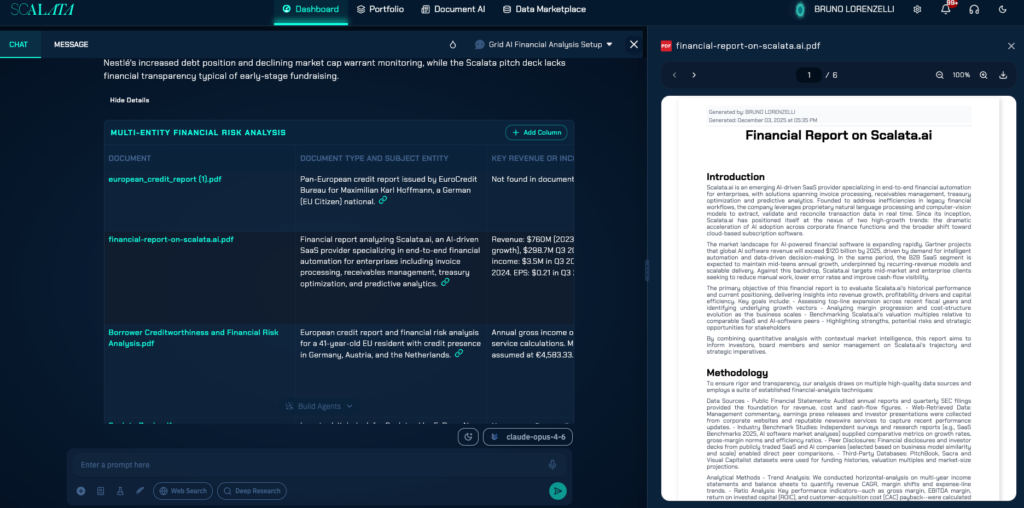
Grid AI platforms like Hebbia, AlphaSense, and Perplexity AI fit squarely into this category. They augment human workflows. But they do not replace them.
A New Shift Is Emerging
AI is moving from: 👉 co-pilot → operator
This is the rise of: 👉 agentic AI
The clearest public signal of this shift arrived in early 2026 with Perplexity Computer — a system Perplexity explicitly described as one that “reasons, delegates, searches, builds, remembers, codes, and delivers.” You give it an outcome. It decomposes the goal into tasks and subtasks, spawns sub-agents, runs them asynchronously in parallel, and returns a finished deliverable.
This is the paradigm shift:
- from answering questions → to sequencing work
- from generating text → to building deliverables
- from chat sessions → to goal-driven execution
Perplexity Computer has validated this direction for the broader market.
But it was built for general knowledge work — not for the operational, regulated, data-sensitive reality of financial institutions.
That gap is exactly where the next generation of finance-native agentic systems is being built.
What Changes with Agentic Systems
Instead of waiting for prompts, systems can:
- ingest new data automatically
- detect changes and anomalies
- trigger workflows
- generate reports
- update outputs continuously
- sequence research → analysis → deliverable end-to-end
- run many workflows concurrently under scoped control
This transforms AI from: a tool you use
to: 👉 a system that works.
Why This Matters in Finance
Financial workflows are:
- repetitive
- data-heavy
- time-sensitive
- compliance-driven
Examples:
- credit monitoring
- remittance reporting
- covenant tracking
- portfolio surveillance
These are not one-time analyses. They are: 👉 continuous processes.
And they don’t run one at a time. A credit team runs covenant checks, portfolio monitoring, remittance reconciliation, and counterparty reporting simultaneously — each with different data access rules, different stakeholders, and different compliance requirements.
Limitations of Current Grid AI and General Agentic Systems
Even the most advanced platforms — including sequenced agents like Perplexity Computer — have real limits for institutional use:
- Task-based, not state-based — Computer excels at “build me this deliverable” but is not architected for continuous, always-on monitoring of a live institutional dataset.
- Parallel tasks, not concurrent controlled agents — running multiple Computers in parallel is not the same as running concurrent agents with scoped permissions, distinct audiences, and precise content controls over the same institutional data.
- General-purpose governance — citations, audit logs, and approval gates exist, but not the institution-grade guardrails, role-based enforcement, data lineage, and redaction controls regulated finance requires.
- Outputs live outside the institutional system — a beautifully sequenced deliverable still has to be manually plugged into the credit model, the reporting pipeline, the risk dashboard.
They are advancing — but they remain, fundamentally: 👉 general-purpose productivity systems.
Scalata.ai: Introducing Financial “Digital Employees”
Scalata is built around a different concept: 👉 AI agents as operational participants inside financial systems.
These agents don’t just assist — and they don’t just build one-off deliverables. They execute workflows, continuously, concurrently, and under institutional control.
1. Execute End-to-End Workflows
- ingest and normalize data
- run analysis
- generate outputs
- feed institutional systems directly
No manual handoffs between steps.
2. Continuous, Always-On Intelligence
- track portfolio changes
- update insights in real time
- monitor conditions 24/7
Not session-based. Not task-based. State-based. The system is always on.
3. Sequenced Agentic Execution — Powered by Unique Code & Widget Generation
Here Scalata meets — and extends — the Perplexity Computer paradigm.
Computer sequences research and content building. Scalata already does this for finance, powered by its unique code generation and widget sequence technology:
- every step of a financial workflow is backed by purpose-built, auto-generated code
- each step produces a reusable widget — a covenant calc, a remittance reconciler, a portfolio exposure view
- widgets compose into workflows, and workflows compose into operational systems
- the deliverable is not a PDF — it’s a live, executable piece of institutional infrastructure
4. Concurrent Chatbots and Agents — With Precise Content Control
This is where Scalata most clearly differentiates from general-purpose agentic systems.
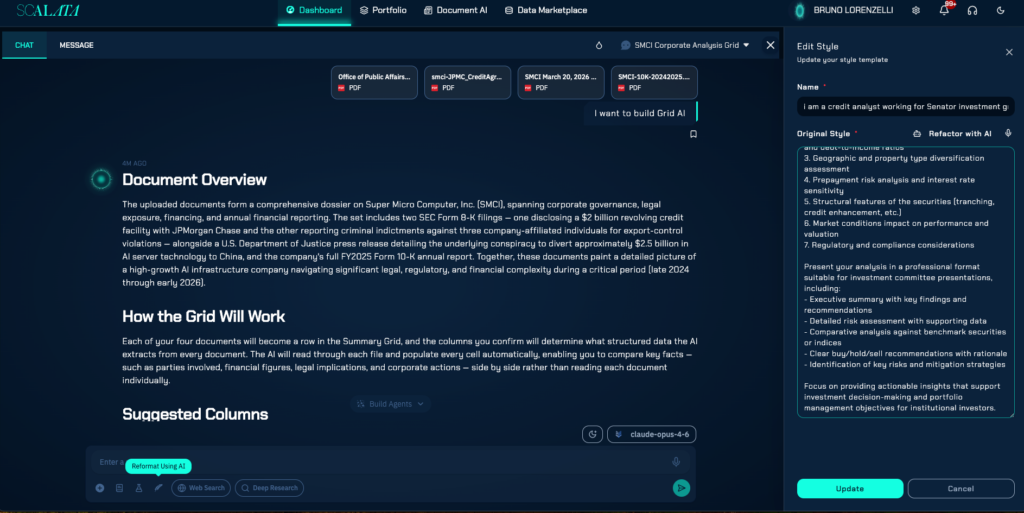
Scalata is capable of processing multiple chatbots and agentic tasks concurrently, each with:
- its own scoped data access
- its own role-based permissions
- its own output controls
- its own audience (internal teams, clients, counterparties)
- its own audit trail
Precise control over content means one chatbot can serve credit analysts with full borrower detail while another serves external counterparties with redacted, permissioned outputs — simultaneously, from the same underlying dataset, under the same policy framework.
Perplexity Computer runs parallel tasks. Scalata runs concurrent, controlled, permissioned digital employees.
That’s the difference between productivity software and institutional infrastructure.
5. Trigger Actions
- alerts
- reports
- compliance checks
- downstream workflow initiation
AI moves from insight → execution.
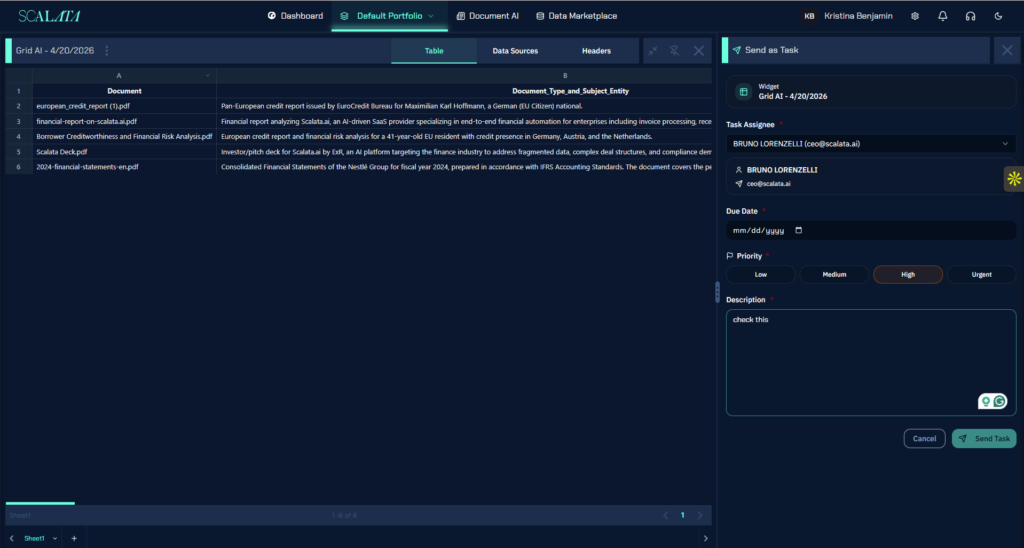
Execution in action: a digital employee doesn’t just deliver analysis — it triggers downstream work. Here, a grid output is routed as a high-priority task directly to a specific team member, with full audit metadata attached.
6. Built-In Compliance AI (Policies & Guardrails)
- policy-based controls on data access and usage
- validation checks before outputs are used or shared
- workflows aligned with internal rules
👉 Compliance is embedded — not an afterthought.
7. Data Governance + Permissions
- full data lineage and auditability
- role-based access control
- permissioned workflows
Every output is traceable and controlled.
8. Secure Sharing + External Controls
- share outputs with clients and counterparties
- permissioned access
- redaction and audit logs
AI outputs can safely move beyond internal teams.
This Is Not Just Automation
It’s a shift toward: 👉 AI-native operations.
Where:
- workflows are continuous
- systems are self-updating
- intelligence is embedded
- multiple agents collaborate under policy
- every action is accountable
The Bigger Picture
Financial AI is evolving across three stages:
1. Co-Pilot AI — Assistive tools (search, chat, summaries) AlphaSense, early Perplexity, ChatGPT
2. Interactive AI (Grid Systems) — Structured, parallel analysis Hebbia Matrix, AlphaSense Gen AI
3. Agentic AI Systems — Sequenced execution + monitoring + governance Perplexity Computer (general purpose) · Scalata.ai (finance-native, concurrent, controlled)
Perplexity has proven that stage 3 is the destination for general knowledge work. Scalata is building stage 3 for the institutions that cannot operate without concurrency, compliance, and control.
Final Thought
The first wave of AI made analysts faster. The second wave made data structured. The third wave — visible now in Perplexity Computer’s sequenced agents — will: 👉 run the workflows themselves.
But in financial services, running the workflows isn’t enough.
You have to run many workflows at once — each with different data access, different audiences, different compliance envelopes — with precise control over what every agent sees, produces, and shares.
That is what Scalata.ai’s unique code generation, widget sequence technology, and concurrent multi-agent orchestration deliver.
And in financial services: that is where the real transformation begins.
