
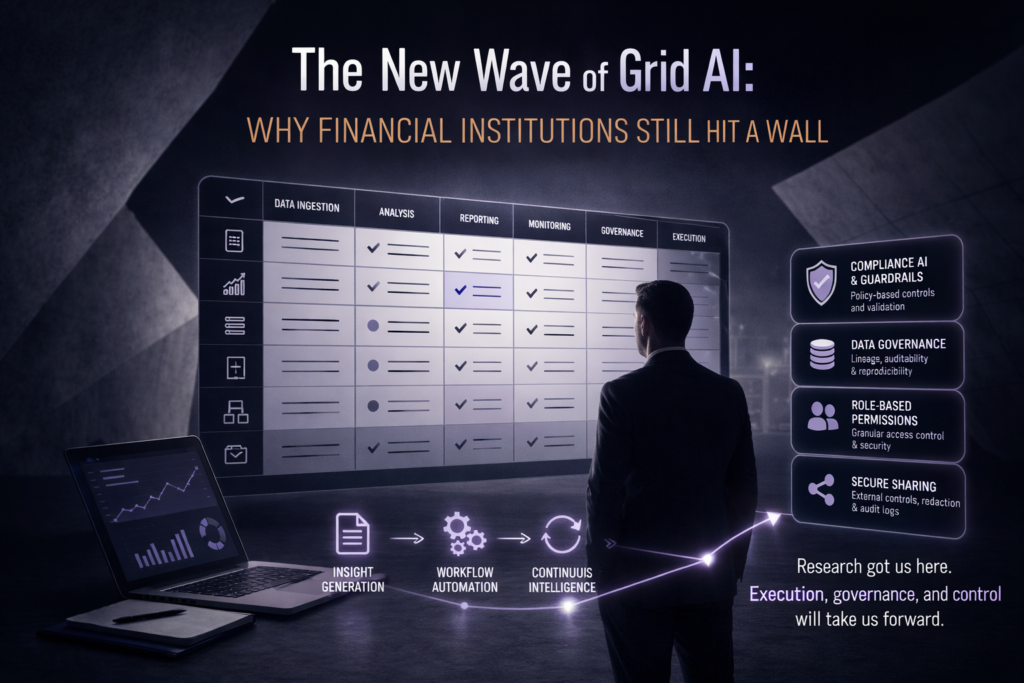
AI adoption in financial services often follows a predictable pattern:
- Excitement — powerful demos
- Pilot — initial success in research teams
- Friction — difficulty scaling
- Stall — limited production adoption
Platforms like AlphaSense, Hebbia, and now Perplexity Computer have dramatically improved steps 1 and 2.
But many institutions are still stuck at step 3.
What These Platforms Do Extremely Well
AlphaSense
- proprietary data + search + AI
- strong for market intelligence and research workflows
- excellent for finding signals quickly
Hebbia (Matrix)
- structured parallel querying across documents
- powerful for due diligence and large dataset analysis
- introduces the “grid” paradigm
Perplexity Computer
- sequenced, goal-driven research and content building
- decomposes an objective into subtasks, spins up sub-agents, runs them in parallel
- multi-model orchestration — routes subtasks to the best-fit model
- produces finished deliverables (reports, dashboards, code) asynchronously
- represents the clearest example yet of AI moving from “answer a question” to “build the thing”
These are major breakthroughs.
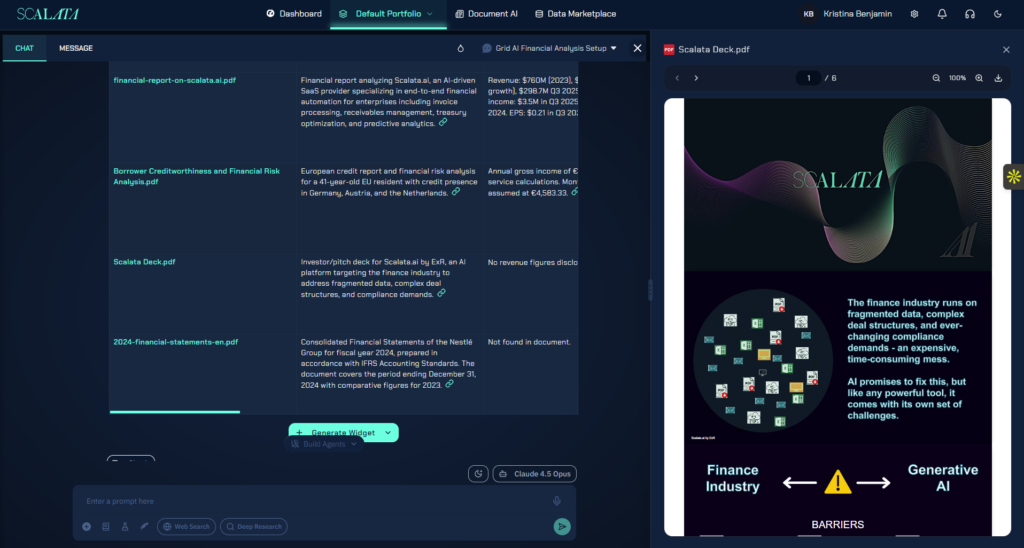
Where the Friction Begins
When institutions try to scale these tools:
1. Outputs Don’t Translate Into Institutional Workflows
Even Perplexity Computer — which goes further than any of them by actually producing the deliverable — generates outputs that still must be manually transferred into:
- credit memos
- internal models
- regulated reports
- compliance dashboards
The deliverable is generated. But the institutional system it needs to live inside? That’s still a manual handoff.
2. No Continuous State
Most systems — including sequenced agents like Computer — are task-based, not state-based:
- you describe an outcome
- the system builds it
- it delivers
- it stops
That model is excellent for “build me a competitive landscape.” It is not how covenant monitoring, remittance reconciliation, or portfolio surveillance work. Those require always-on state, not on-demand sequences.
3. Governance Is Surface-Level
Citations exist — but institutions need:
- full audit trails
- reproducibility
- policy enforcement
- permission structures
- redaction controls on shared outputs
- data lineage back to source
General-purpose sequenced agents were not built for a regulated data environment.
4. Single-Task Orientation, Not Concurrent Operations
Perplexity Computer advertises running “dozens of Computers in parallel” — but each is an isolated task. That’s different from what a financial operations team actually needs:
Multiple coordinated agents, each with distinct permissions, operating concurrently on the same institutional dataset, with precise control over what each one can see, produce, and share.
That’s not parallel tasks. That’s concurrent controlled agents — a different architectural requirement.
Why This Matters
Financial institutions don’t operate on insights alone. They don’t even operate on deliverables alone.
They operate on: 👉 systems of record and systems of execution — running continuously, concurrently, under policy.
If AI cannot plug into those systems: it remains a productivity tool — not infrastructure.
Scalata.ai: Solving the “Last Mile” Problem
Scalata is designed specifically for this gap.
It extends beyond research and beyond sequenced deliverable-generation into: 👉 execution + infrastructure + concurrent control.
Key differentiators:
1. End-to-End Workflow Integration
From: data ingestion → normalization → analysis → reporting → monitoring
Scalata connects AI outputs directly into operational systems — eliminating manual handoffs between insight and execution.
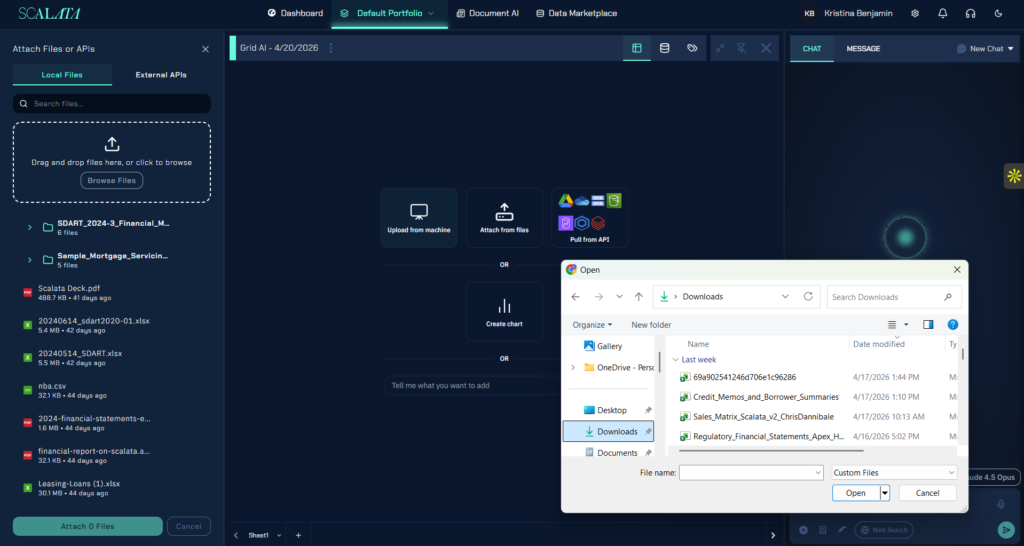
Data ingestion is step one of the workflow, not a separate project. Local files, external APIs, and enterprise data sources connect directly into the same operational surface.
2. Sequenced Agentic AI — With Finance-Native Code & Widget Generation
This is where Scalata meets the Perplexity Computer paradigm head-on.
Computer decomposes goals into subtasks and generates deliverables. Scalata does the same — and goes further with its unique code generation and widget sequence technology:
- every step in a financial workflow generates purpose-built code and interactive widgets
- widgets are composable and reusable — a covenant check generated once becomes a building block for portfolio monitoring
- the output isn’t a static report; it’s a live, executable component of the institutional system
- sequences are financial-native (credit, covenant, remittance, risk) — not general-purpose
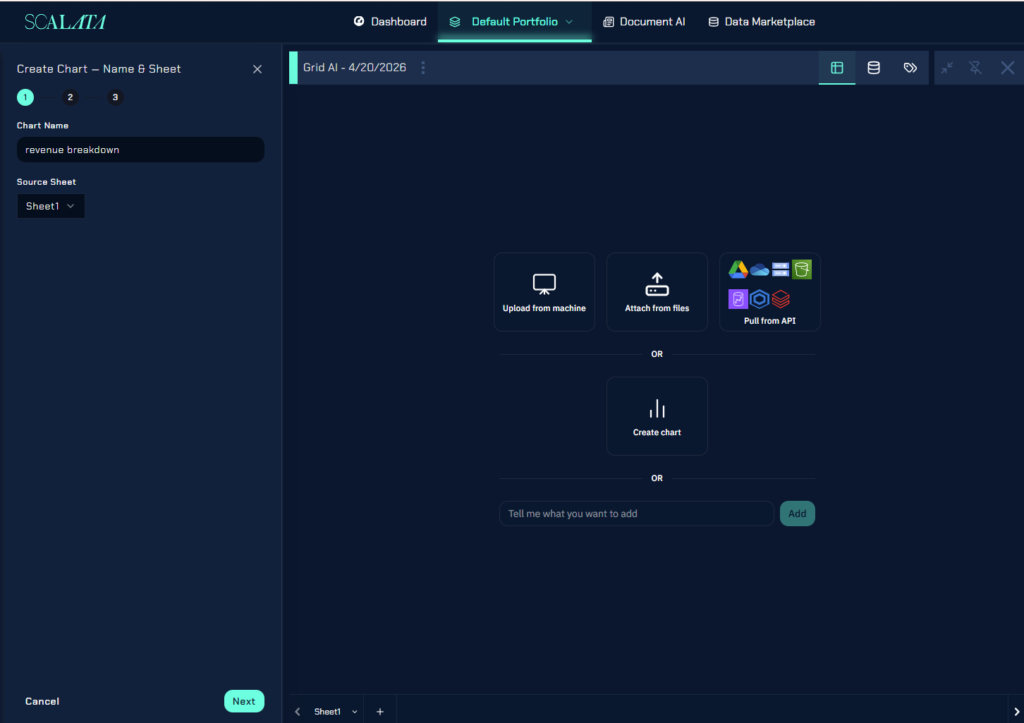
Widget sequence, step 1: every output starts as a named, sourced component — not a one-off artifact.
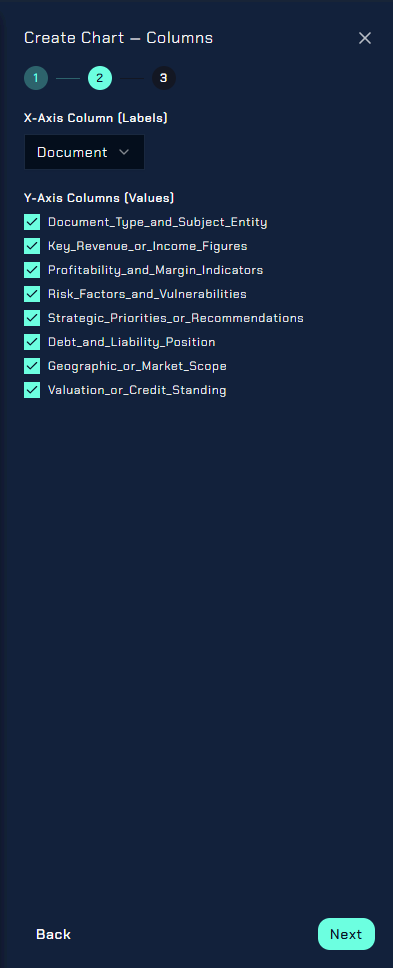
Widget sequence, step 2: the widget is wired directly to the underlying grid columns, preserving lineage end-to-end.
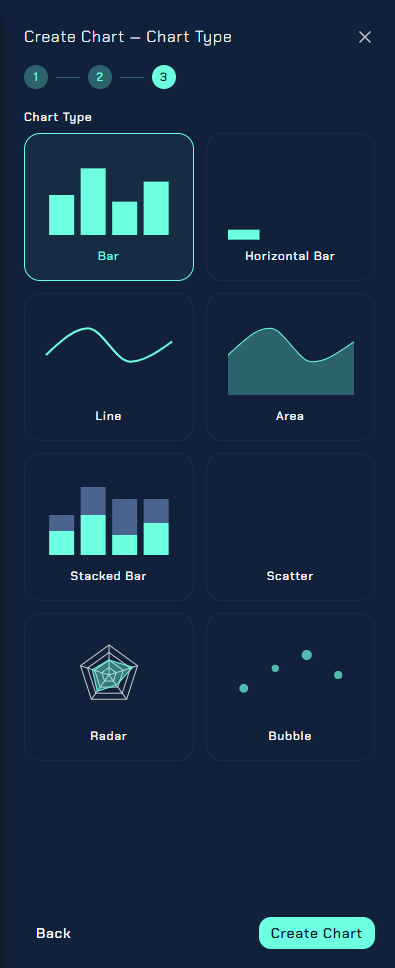
Widget sequence, step 3: the final deliverable is rendered as code-generated, live, and composable — ready to plug into larger workflows.
3. Concurrent Chatbot & Agent Orchestration with Precise Content Control
This is the capability that distinguishes Scalata most sharply from general-purpose agentic systems.
Scalata is capable of processing multiple chatbots and agentic tasks concurrently — each with:
- its own scoped data access
- its own role-based permissions
- its own content controls
- its own compliance envelope
- its own audit trail
One chatbot serves the credit team with full borrower detail. Another serves counterparties with redacted, permissioned outputs. A third runs covenant surveillance in the background. A fourth answers portfolio manager queries. All operating simultaneously, with precise control over the content each one produces.
Perplexity Computer runs parallel tasks. Scalata runs concurrent, controlled, permissioned agents — the distinction that matters inside a regulated institution.
4. Persistent Intelligence
Not session-based:
- always-on monitoring
- real-time updates
- lifecycle tracking
Financial data becomes a continuously evolving system, not a static query result or a one-shot deliverable.
5. Compliance AI: Policies, Guardrails, and Control
Scalata embeds compliance directly into the AI layer — ensuring every interaction operates within institutional rules.
This includes:
- policy-based guardrails governing how data is accessed and used
- real-time validation checks before outputs are consumed or shared
- controlled AI behavior aligned with internal risk and compliance frameworks
👉 Compliance is not a downstream process — it is built into the system itself.
6. Data Governance + Lineage
Every data point and output is fully traceable:
- source-level lineage tracking
- transformation visibility
- reproducible outputs
This ensures AI results can be: ✔ audited ✔ validated ✔ trusted in production environments
7. Role-Based Permissions + Access Control
Scalata enforces granular control across users and teams:
- role-based data access
- permissioned workflows
- restricted interaction with sensitive datasets
Different stakeholders (analysts, risk, compliance, leadership) interact with the system within defined boundaries.
8. Workflow Sharing + External Controls
Financial workflows extend beyond internal teams.
Scalata enables:
- secure sharing of outputs with clients and counterparties
- permissioned external access
- data filtering and redaction controls
- full audit logs of what was shared, when, and by whom
This allows AI-generated outputs to safely move across institutional boundaries.
9. Deep Governance Infrastructure
Built-in:
- auditability
- lineage tracking
- policy enforcement
- system-wide controls
Ensuring every AI-driven workflow is: ✔ governed ✔ compliant ✔ institution-ready
The Real Bottleneck in Financial AI
It’s not model quality. It’s not even sequenced task execution anymore — Perplexity has proven that works.
It’s: 👉 integration into real-world institutional systems, with concurrent controlled agents, under policy.
Final Thought
AlphaSense and Hebbia redefined research. Perplexity Computer redefined agentic deliverable-building.
But scaling AI in finance requires more than research, and more than sequenced deliverables.
It requires:
- execution
- persistence
- concurrency
- governance
- control
👉 The institutions that solve this layer will define the next decade of financial infrastructure.
And Scalata.ai is already there.
