Meet the Digital Employee: What Happens When AI Gets a Seat on the Org Chart
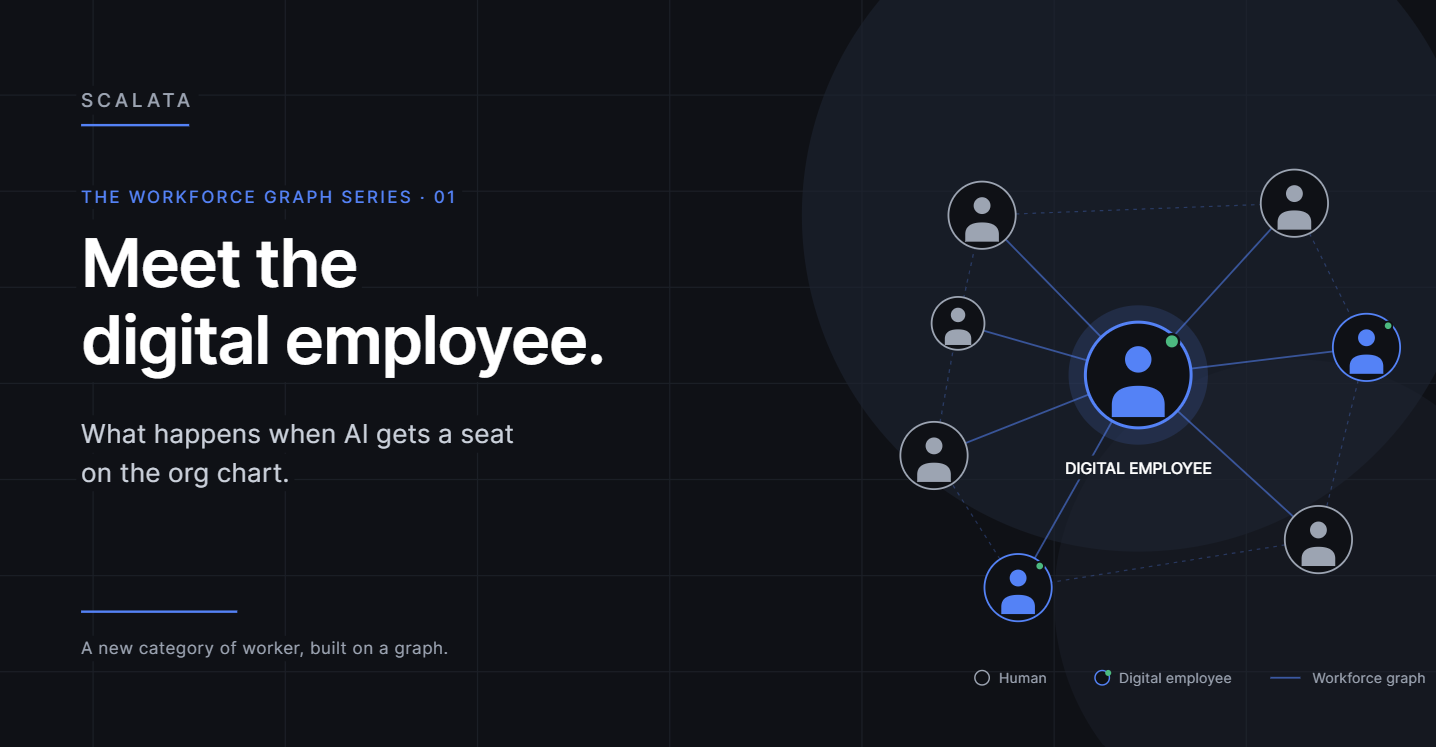 Meet the digital employee — the Workforce Graph Series
For most of the last decade, "AI at work" meant a chatbot bolted onto a support queue or a model buried inside a piece of software you already used. Useful, sometimes. Transformational, rarely. The work still sat with people, and the AI sat adjacent to it.
That framing is breaking down. A new category is emerging, and at Scalata we call it what it is: the digital employee.
A digital employee is not a chatbot
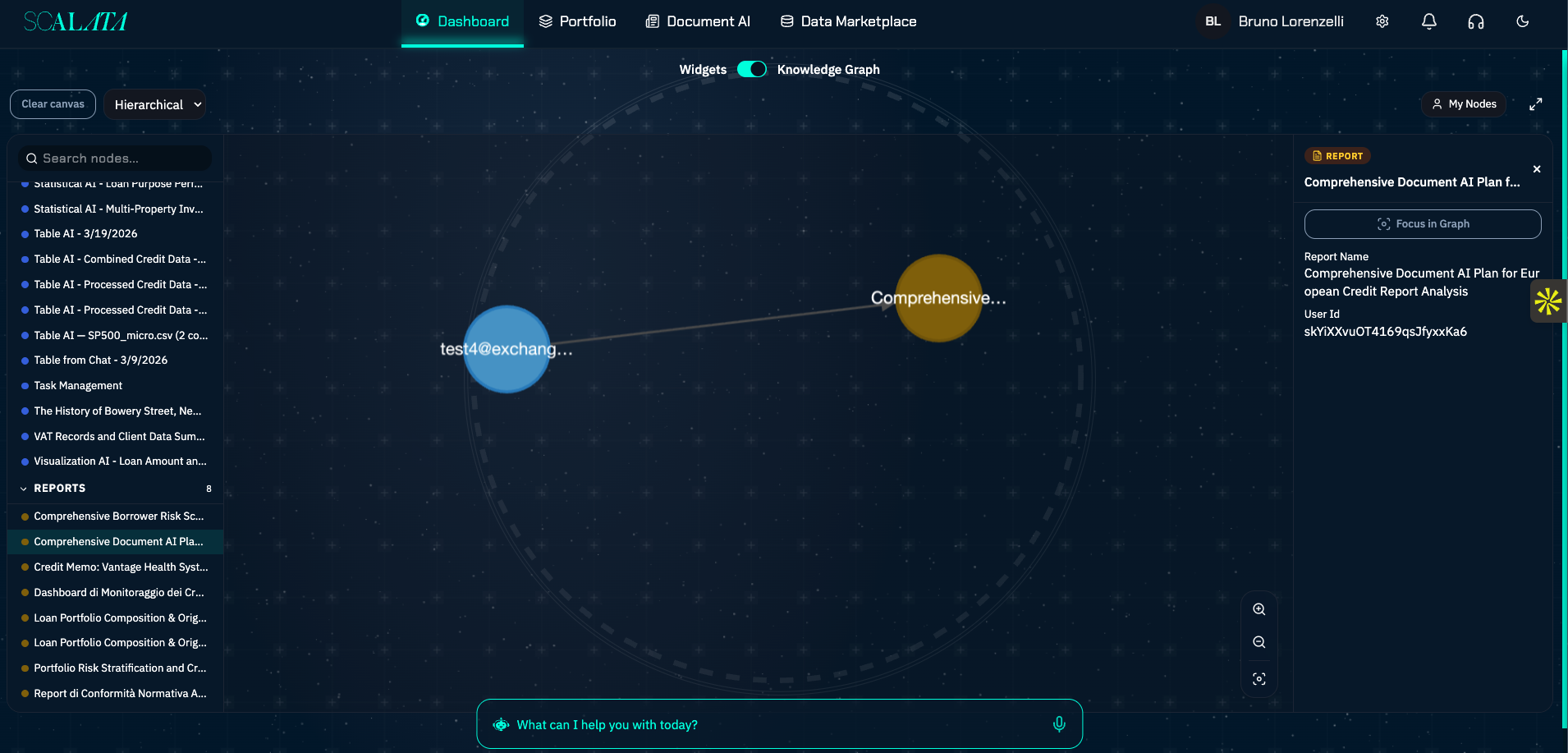 The Scalata workspace — every node is a person, agent, team, or workflow, on one graph.
A chatbot answers a question. A digital employee owns a role. The distinction matters more than it sounds. Roles have responsibilities, dependencies, access rights, handoffs, KPIs, and relationships with other people in the business. When you hire a human analyst, you don't just hand them a keyboard — you place them inside a team, give them tools, tell them who they report to, who they collaborate with, and what "done" looks like. You give them an email address and a badge. You add them to the weekly standup. You give them a manager who is accountable for their output. A digital employee needs all of that too, or it isn't really an employee — it's just another piece of software you've added to the pile.
That's the shift. We're moving from AI as a feature inside a tool to AI as a worker inside an organization. The unit of value stops being "this app got smarter" and becomes "this role is now filled, partially or fully, by a digital entity that behaves like a colleague."
It's a bigger change than it looks. It reframes the conversation from IT-led to operations-led. It moves AI out of the innovation lab and into the P&L. And it forces every company to answer a question most of them have been dodging: if AI is going to do actual work inside our business, what does the structure around that work need to look like?
The problem: where does a digital employee actually live?
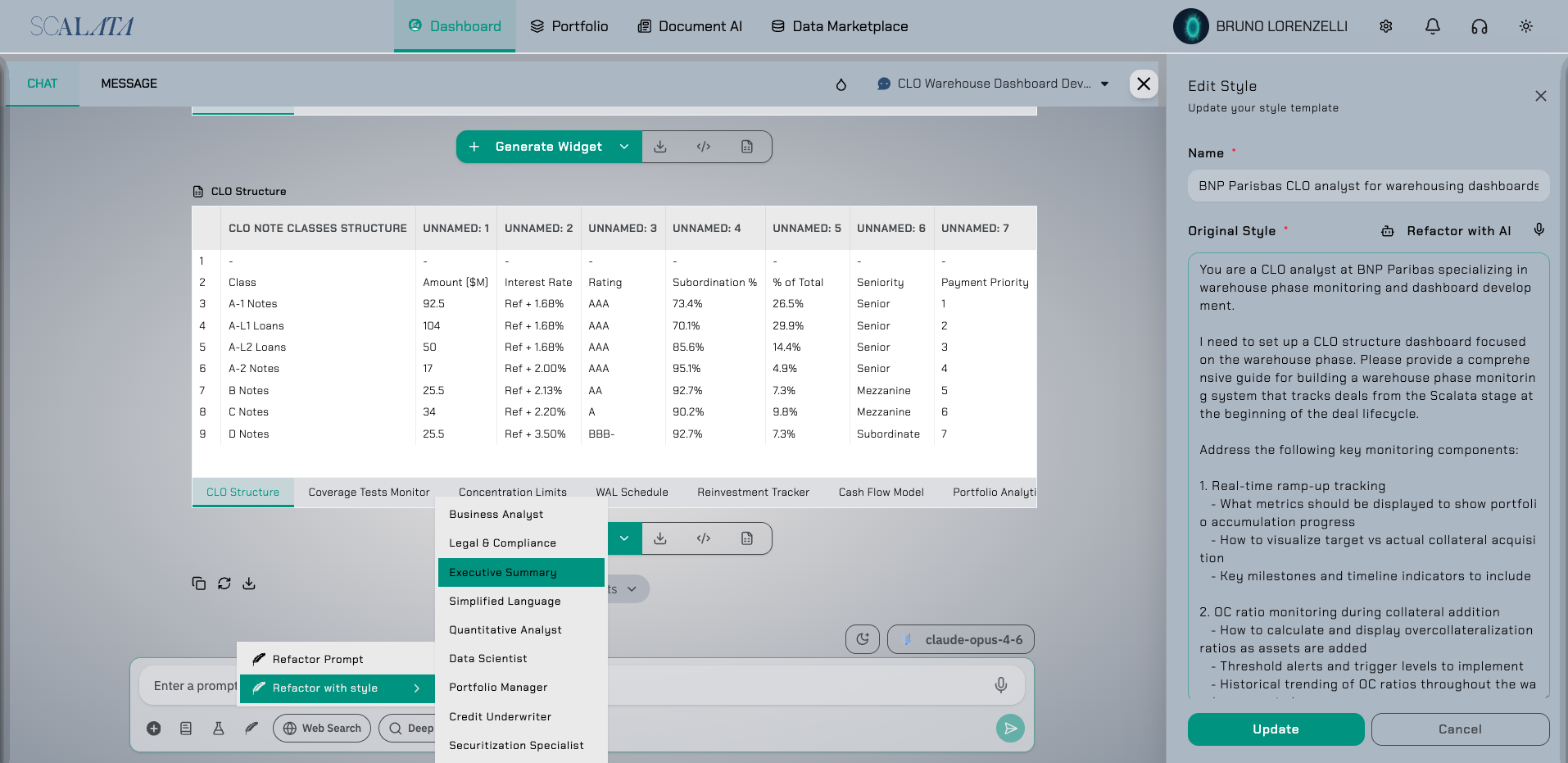 Refactoring a digital employee's instructions with AI, right inside the graph.
Here's where most companies get stuck. You can spin up an agent in an afternoon. The model is capable. The tools exist. Standing up something that demos well is genuinely easy. But where does it sit? Who does it report to? What systems is it allowed to touch, and at what level? Which human picks up the work when it escalates, and how does that human know it was escalated in the first place? What happens when a team reorganizes and the digital employee's manager leaves? How do you even answer the question "what do our digital employees do" six months from now?
Answer those questions with documents and Slack threads and you end up with AI sprawl — dozens of agents scattered across teams, no one clear on what each does, no consistent governance, no way to see them as a whole. We've seen this play out. A company deploys five agents in its first year, fifteen in its second, and by year three nobody can produce a clean list of what exists, who owns what, and which systems are being touched by which automated entity.
This isn't a theoretical risk. It's already happening. It's the natural end state of deploying AI workers without any substrate underneath them. This is why Scalata is built on a workforce graph.
The graph is the org chart, made real
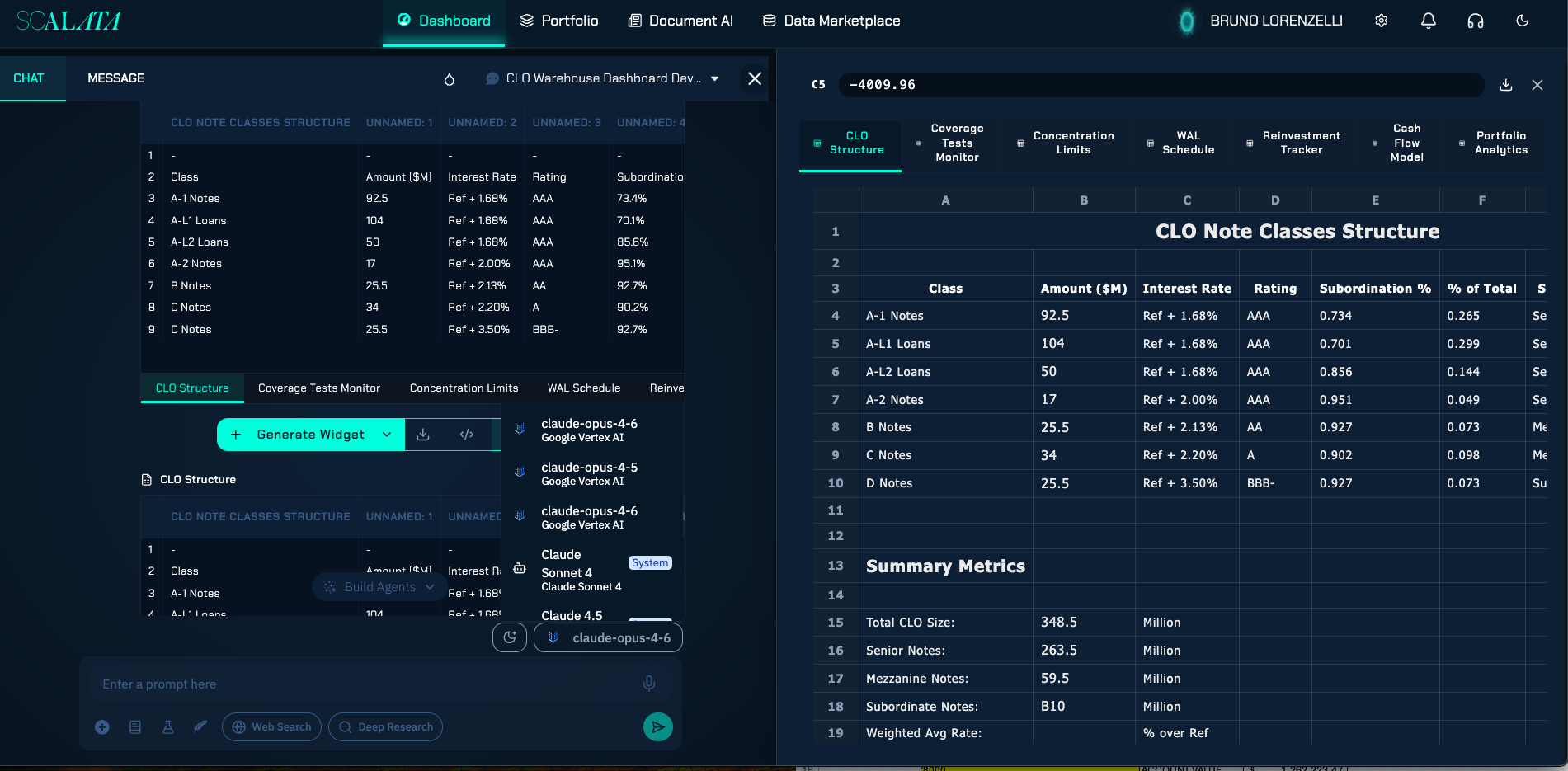 A CLO structure dashboard, generated and monitored by a digital employee.
A graph is a way of representing things and the relationships between them. In the Scalata graph, the things are people, digital employees, teams, tools, tasks, and workflows. The relationships are the connective tissue of the business: who reports to whom, who owns what, what triggers what, who has access to which system, who escalates to whom when something goes sideways.
When you onboard a digital employee into Scalata, you're not dropping an agent into the void. You're attaching a person-agent — an entity with identity, skills, and permissions — to a node in the graph. That node sits inside your actual org structure. It has neighbors. It has a manager. It has a queue of work that flows in from upstream nodes and out to downstream ones. It participates in the same workflows humans do, because those workflows live in the same graph.
Suddenly, the digital employee is legible. You can see what it does, who it works with, what it has access to, and what the business would look like without it. This is not a cosmetic change. It's the difference between running a business that happens to use AI and running a business that has an operating model for AI. One is fragile. The other compounds.
How Scalata does this differently
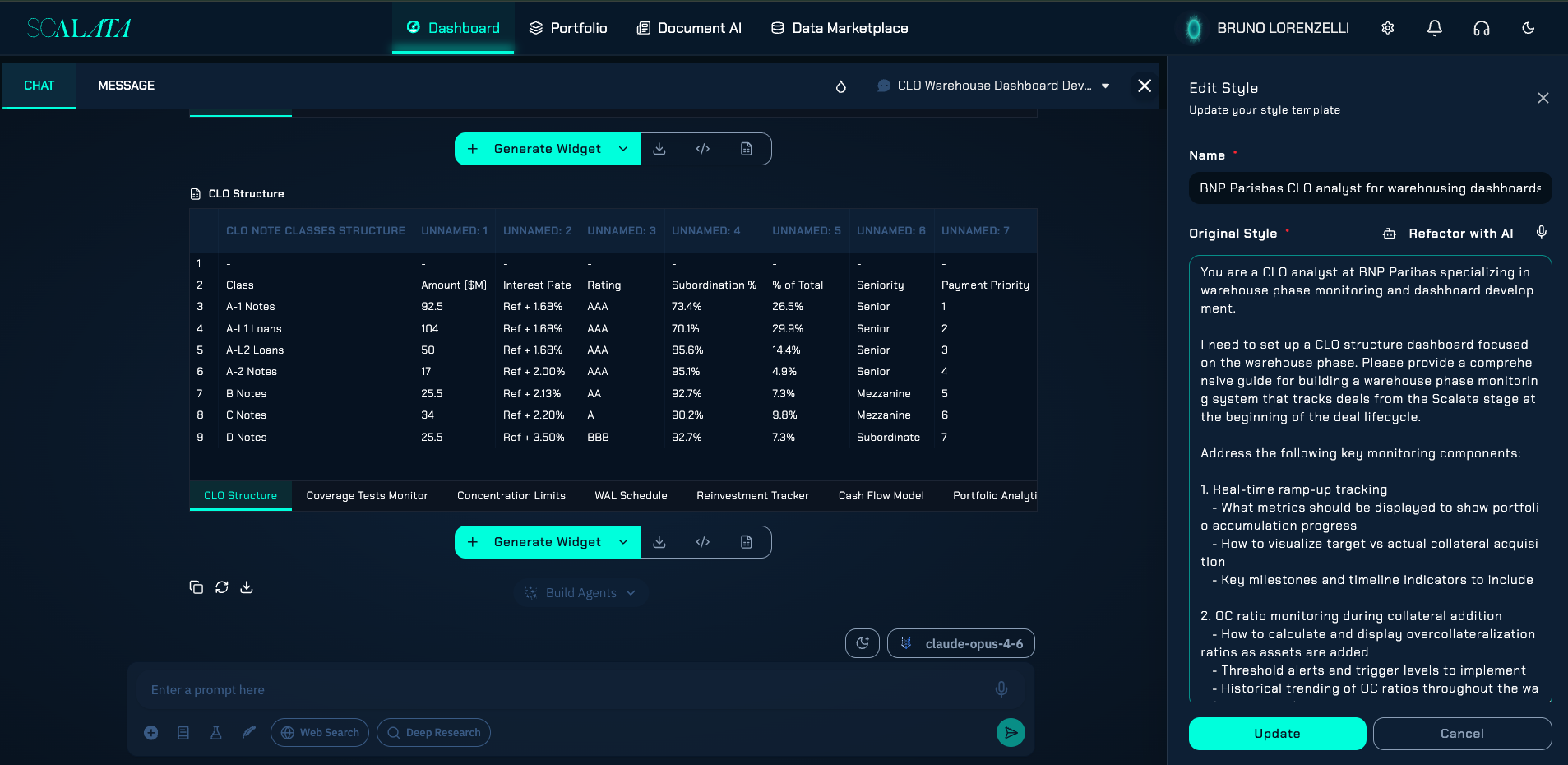 Composing widgets — the building blocks a digital employee assembles into an answer.
There's no shortage of vendors selling "AI agents for the enterprise." Most are some combination of a model, a few connectors, and a UI. They demo well. They struggle the moment a serious enterprise asks the next question: who is accountable for what this thing does? Scalata's answer is structural. Because every digital employee is a node in a workforce graph — not a script, not a session, not a workflow buried inside someone's automation tool — it inherits the same governance properties your human workforce does:
- Identity and accountability by default. Every action is attributable to a named entity with a manager and a place in the org. Most agent platforms log API calls. We log workforce activity — the difference shows up immediately during a SOC 2 audit, an internal investigation, or a regulator's request.
- Permissions as graph edges, not config files. Other platforms store permissions inside the agent, so changing them means touching the agent, which means change management, which means risk. Scalata's permissions are edges in the graph. Your security team revokes access by editing the graph, and every workflow that depends on that edge updates instantly.
- Built for regulated industries from day one. Financial services, healthcare, insurance, and the public sector can't deploy black-box agents outside their compliance perimeter. Scalata's graph is the compliance perimeter — every digital employee is inside it, by construction. There's nothing to retrofit.
- No AI sprawl. Elsewhere, every team that wants an agent creates one, and within a year you have dozens of disconnected automations. Scalata's graph is the central registry: new digital employees attach to it, old ones retire from it, and the CIO and the head of operations look at the same picture.
- A real management layer. Other tools give you a console for monitoring agents. Scalata gives you a workforce — with managers, teams, performance history, and the ability to expand or contract scope the way you would for a human hire.
The companies betting on AI as a workforce — not as a feature — need infrastructure that treats it that way. That's the bet behind Scalata, and it's why customers in regulated industries choose us over platforms without a coherent answer to "but who's accountable, and how do you prove it?"
Why this matters now, not later
 An audit-ready report generated and deployed end-to-end by a Scalata digital employee.
The companies that win the next decade won't be the ones with the most AI tools. Tools are a commodity. They'll be the ones who can actually operate a hybrid workforce — humans and digital employees working side by side, with clear ownership, clear accountability, and enough structure that the whole thing keeps working when it scales from five digital employees to five hundred.
The companies that struggle will be the ones who treated this like a tooling decision instead of a workforce decision. They'll have capable agents and no way to govern them. They'll have automation and no audit trail. They'll have productivity in pockets and chaos everywhere else.
You can't operate what you can't see. A workforce graph is how you see it. It's also how you run it, grow it, audit it, and eventually how you evolve it into something your competitors can't copy even if they wanted to — because the graph is the moat.
In the next post in this series, we'll go deeper on the graph itself: why nodes and edges are a dramatically better substrate for a modern workforce than the org charts and spreadsheets most companies still run on — and what you can actually do with a graph that you can't do with anything else.