
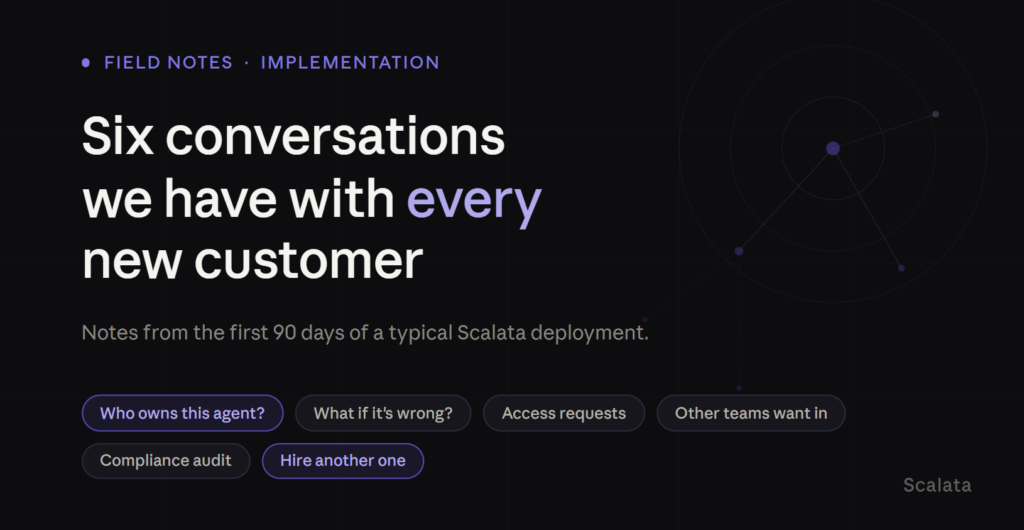
They always start with the same question. The answer is never the one they expect. Notes from the first ninety days of a typical Scalata AI deployment.
Every implementation follows roughly the same arc. A company comes in excited about the technology. They’ve read about agentic AI, they’ve seen demos, they have genuine use cases in mind. Then, somewhere between week two and week four, they hit a wall — not a technical wall, but an organizational one. The wall is always the same wall. It’s made entirely of questions nobody has thought to answer yet.
We’ve run enough of these deployments to know what the questions are before they get asked. Here are the six that come up every time — and what we’ve learned about working through them.
Conversation 01 · ~Day 8
“Who actually owns this agent? Like, whose budget is it on?”
This one surprises people because it sounds like a finance question. It isn’t. It’s a governance question. When there’s no clear owner, there’s no one to escalate to when something goes wrong, no one responsible for reviewing output quality, and no one who will notice when the agent’s input distribution shifts because the upstream process changed three months ago.
In regulated environments, this question isn’t optional. If your SOC 2 auditor asks who is accountable for a digital employee’s decisions, “the AI team” is not an answer that holds up.
Without a clear owner: Six months later, no one remembers why it was built the way it was. Performance degrades silently. The team that deployed it has moved on.
With a named owner: Performance reviews happen. Scope expands intentionally. When a regulation changes, one person knows immediately and can act.
Conversation 02 · ~Day 12
“What happens when it gets something wrong?”
The question underneath this question is: does the agent know it got something wrong? And if it does, who does it tell, how fast, and with what level of detail?
Teams that haven’t thought through escalation paths before deployment end up building them reactively — under pressure, after something has already gone sideways. The resulting path is usually a Slack message to someone who may or may not see it, with no guaranteed handoff context and no audit trail.
In Scalata, escalation paths are edges in the graph. The agent doesn’t decide whether to escalate — the structure decides for it. This distinction matters more than it sounds. “The agent should escalate when it’s uncertain” is a prompt. “The agent cannot proceed without approval from a human in role X” is a constraint. Only one of those holds up under audit.
Conversation 03 · ~Day 19
“Can we give it access to the CRM? And also the billing system? And maybe Salesforce?”
Access requests always expand. The initial scope is narrow and well-defined. Then someone realizes the agent would be more useful with one more data source. Then another. By month three, a digital employee that was supposed to handle tier-1 support tickets has read access to three systems that were never reviewed together for combined exposure.
In most agent platforms, permissions live inside the agent configuration. Changing them means touching the agent, which means change management, testing, and risk. In Scalata, permissions are edges in the graph — your security team edits the graph, the change takes effect immediately, and the full access history is already there for the next audit. The access request conversation becomes a structured process, not a negotiation conducted over email.
A note on scope creep: The fastest path from “this agent is useful” to “we don’t know what this agent has access to” is about eight months of untracked access requests. We’ve seen companies get there faster. The answer isn’t to say no to every expansion — it’s to make every expansion visible, deliberate, and reversible.
Conversation 04 · ~Day 31
“Other teams keep asking if they can use it. What do we tell them?”
This is usually the first sign that the deployment is working. It’s also the moment that either scales gracefully or turns into AI sprawl.
The team that built the agent owns it. Another team wants to use its capabilities. The request is reasonable. But if the answer is “sure, just talk to it directly,” you now have a second team depending on an agent they don’t own, with no visibility into its configuration, no escalation path they can reach, and no representation on whatever the first team decides to do with it next month.
The right answer involves the graph. A second team attaches to the same node. Their workflows become dependencies. The agent’s owner can see who depends on it. Cross-team usage is visible, auditable, and reversible — not buried in someone else’s Slack.
Conversation 05 · ~Day 45
“Our compliance team wants to know exactly what it did last Tuesday.”
This one arrives without warning. A regulator asks a question, or an internal audit surfaces a transaction, or a customer disputes something that the agent touched. And suddenly “what did it do and why” has to become a precise, timestamped, attributable answer rather than a best-guess reconstruction from logs.
Most agent platforms log API calls. Scalata logs workforce activity. The difference is the difference between “here is a raw log file, good luck” and “here is the complete task history, with the human and digital employees who touched it, the decisions made at each handoff, and the escalation path followed, queryable by date range and role.” Compliance teams have a strong preference for the second version.
Conversation 06 · ~Day 68
“We want to hire another digital employee. How do we do that?”
This is the one we wait for. The first deployment worked. The team has developed a vocabulary for it. They understand what it means for a digital employee to have a role, a manager, a scope, and an escalation path. They want more of it.
The answer, by this point, is that they’ve already done most of the hard work. The onboarding process for the first digital employee forced a clarity about workflows, permissions, and accountability that makes the second significantly faster. By the fifth or sixth, it’s a known pattern — the organizational scaffolding exists, and adding a new node is genuinely lightweight.
This is the compounding effect that graph-based infrastructure creates. It doesn’t just make the first deployment better. It makes every subsequent deployment faster, cheaper, and less risky — because the organizational clarity you built for one digital employee transfers directly to the next.
None of these conversations are about the technology. The model is capable. The connectors exist. The demos work. The hard part — the part that determines whether a deployment succeeds or quietly fails — is the organizational structure underneath it.
The companies that get this right are the ones who treat the first deployment as an investment in infrastructure, not just a proof of concept. They come out of it with clearer processes, better-defined roles, and a pattern they can replicate. The ones who skip it are usually back six months later, untangling something that was always heading toward a mess.
