Perspective
AI Policy Frameworks Are Becoming Mandatory for Financial Institutions
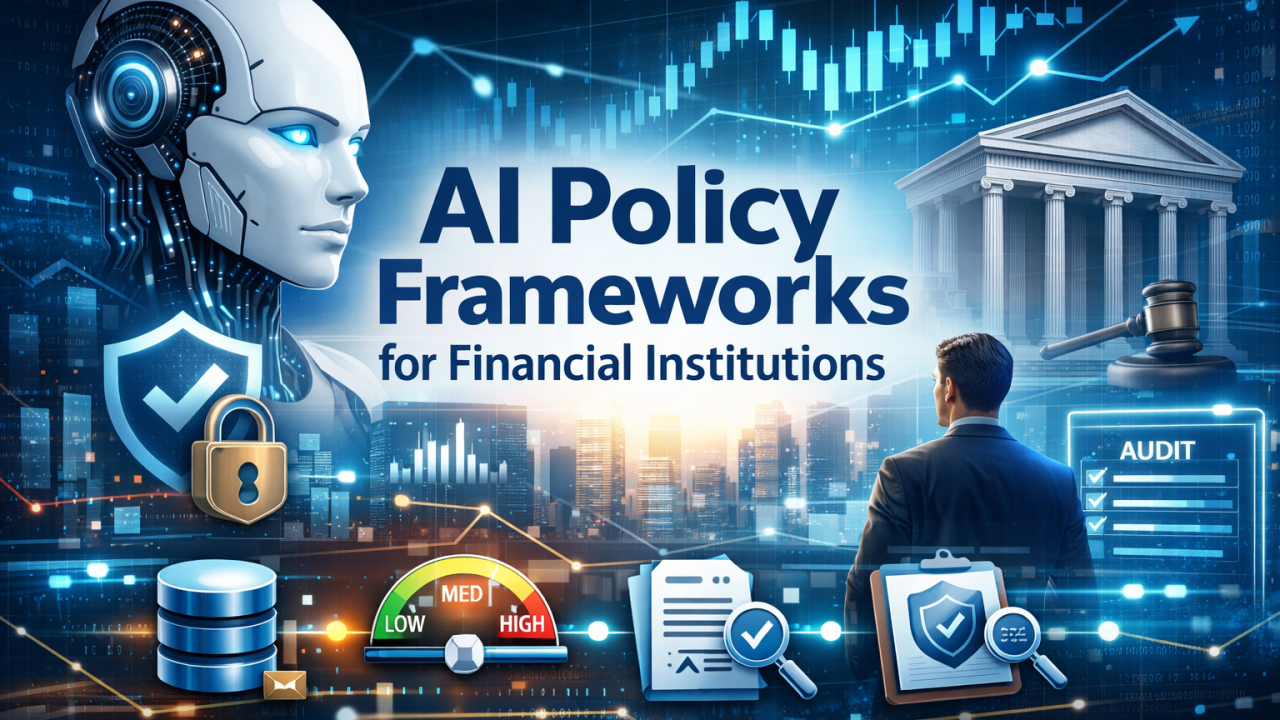 AI Policy Frameworks Are Becoming Mandatory for Financial Institutions
Two years ago, financial institutions were asking:
"Should we experiment with AI?"
Today, the conversation has changed.
"How do we control it?"
Across banks, credit funds, and asset managers, organizations are now developing formal AI policy frameworks to regulate how artificial intelligence is used throughout their institutions.
The Challenge: AI Without Policy
Generative AI introduces a new set of operational risks, including:
- Data leakage
- Hallucinated financial outputs
- Compliance violations
- Lack of auditability
- Unverified analysis
For financial institutions, these risks extend beyond technology—they quickly become regulatory concerns.
This is why many organizations are beginning to govern AI systems in much the same way they manage financial models under established model risk management frameworks.
What an AI Policy Framework Looks Like
Effective AI governance policies generally consist of four core layers.
1. Data Access Policies
AI tools must be prevented from accessing sensitive financial data without appropriate authorization.
Policies typically define:
- Approved datasets
- Restricted confidential information
- Encryption and storage requirements
Scalata enables institutions to control exactly which data sources AI agents can access and analyze.
2. Use-Case Classification
Not every AI application carries the same level of risk.
Many financial institutions classify AI usage into:
- Low Risk – Research assistance and summarization
- Moderate Risk – Internal financial analysis
- High Risk – Credit underwriting or trading decisions
Scalata's structured workflows help organizations standardize how AI is deployed across each of these environments.
3. Output Verification
AI should support decision-making—not replace it.
Financial teams require:
- Human review
- Documented reasoning
- Traceable sources
Scalata produces structured, source-traceable outputs so analysts can quickly validate AI-generated insights.
4. Monitoring and Logging
Compliance teams must be able to review how AI systems are being used across the organization.
Platforms should log:
- Prompts
- Outputs
- Sources
- User activity
- Storage, training, and misuse checks
- Alerts
Scalata maintains audit-ready research logs that help institutions maintain governance and oversight.
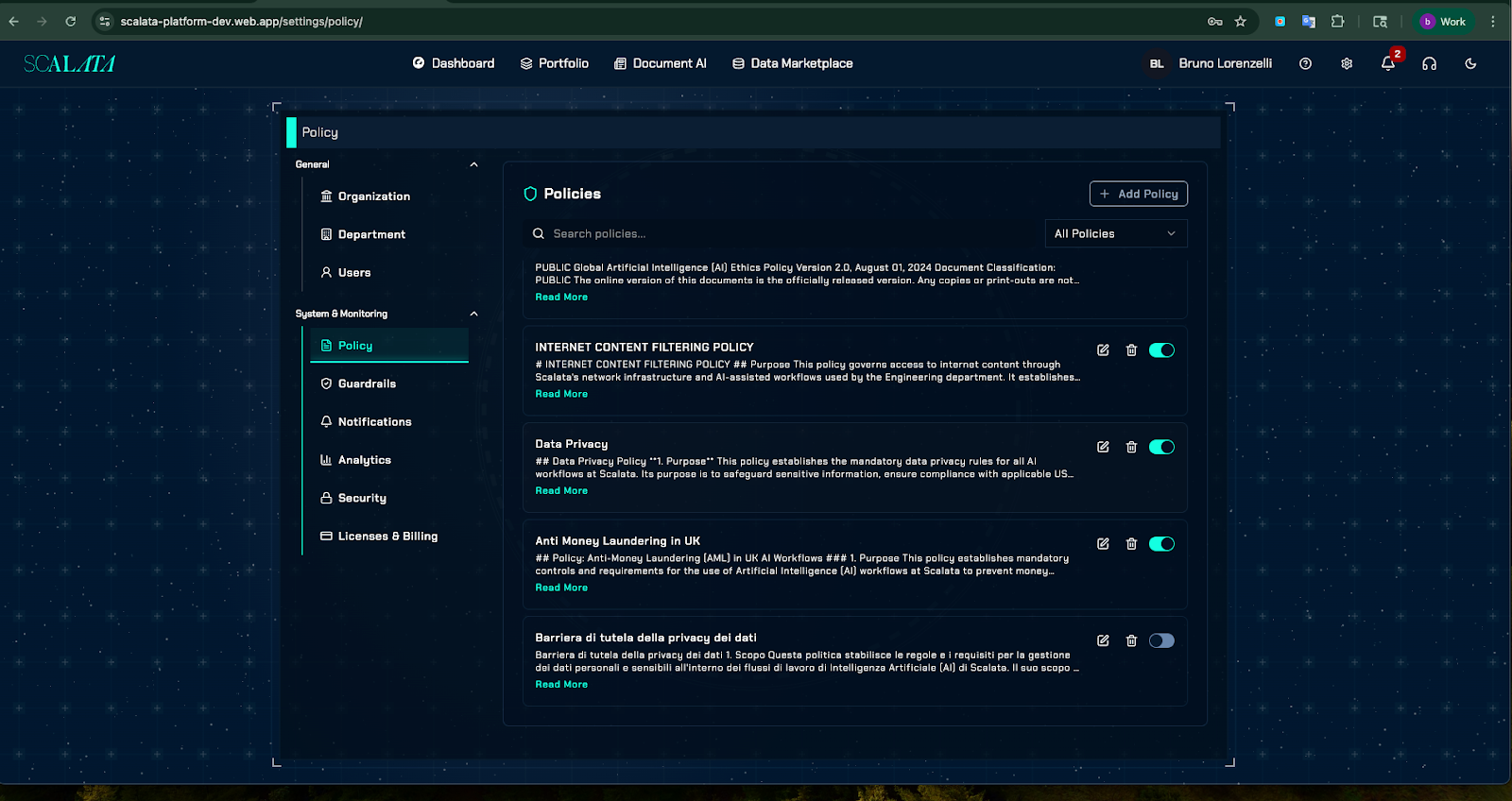 AI Policy Framework
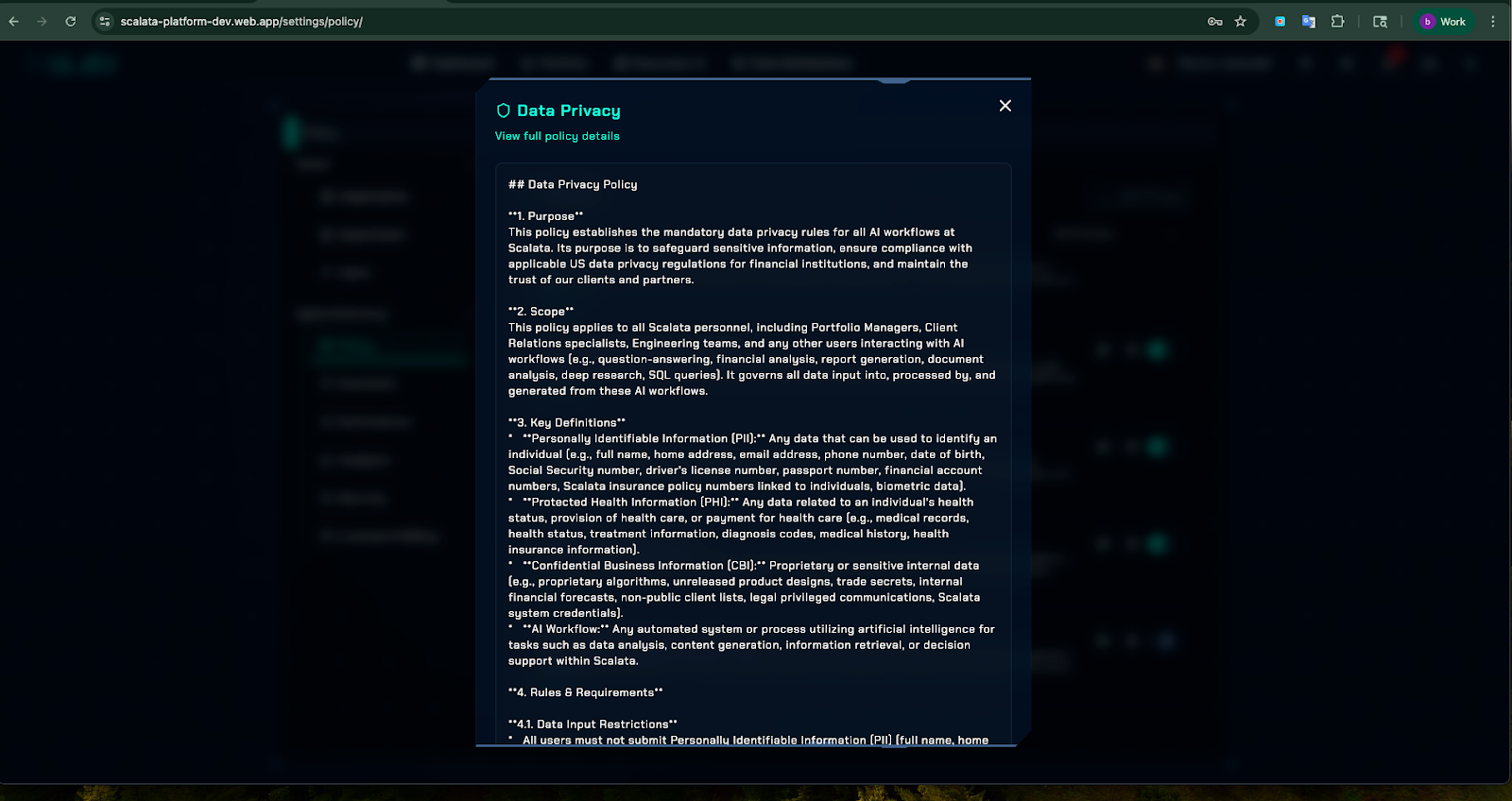 AI Governance Controls
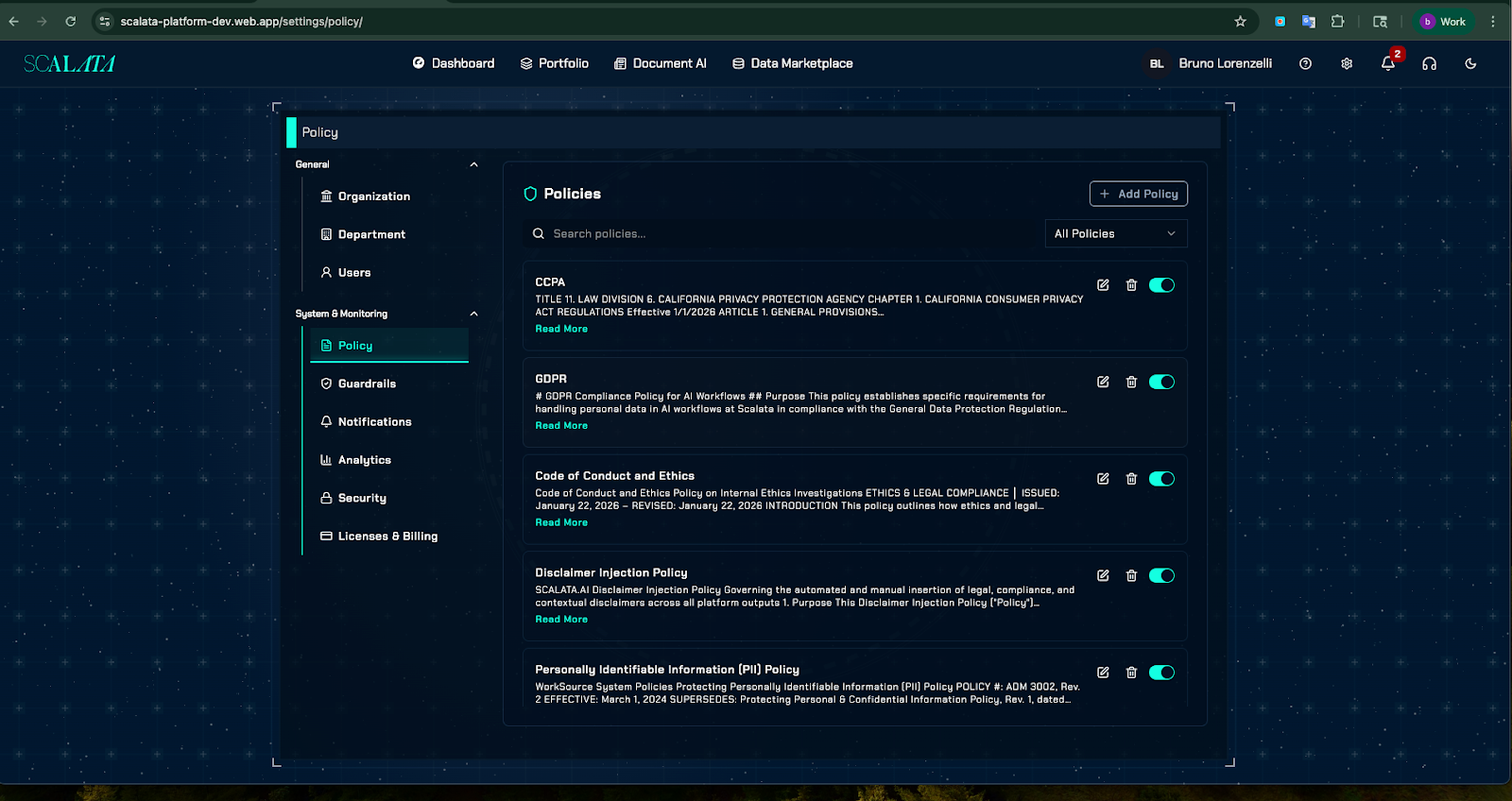 Audit & Monitoring
Real Use Cases Across Financial Institutions
AI policy frameworks are already shaping how financial organizations deploy AI.
Credit Teams
AI can accelerate borrower analysis by summarizing financial statements and identifying key risk signals.
Using structured research agents, Scalata enables credit teams to generate standardized credit insights in minutes instead of hours.
Asset Managers
Investment professionals use AI to analyze markets, earnings reports, and macroeconomic trends.
Scalata's deep research workflows allow analysts to synthesize complex financial data into structured investment insights.
Compliance Teams
Regulatory teams must continuously monitor policy changes and assess risk exposure.
AI-driven research workflows help compliance teams monitor regulatory developments, summarize policy updates, and organize information into structured reports.
Policy Must Be Supported by Infrastructure
Written policies alone cannot control AI usage.
Financial institutions need platforms that enforce governance through technology.
This includes:
- Structured research workflows
- Data governance controls
- Audit logging
- Traceable outputs
Scalata.ai was designed around a policy-driven AI architecture, allowing financial institutions to scale AI adoption while maintaining governance, compliance, and oversight.