Perspective
Before Your Agent Can Reason, It Has to Agree on What Words Mean
 Before Your Agent Can Reason, It Has to Agree on What Words Mean
Before Your Agent Can Reason, It Has to Agree on What Words Mean
Ask anyone who has run a data integration project at a financial institution what actually ate the timeline, and it's rarely the connection itself. It's the translation. One system calls it cpty_id. Another calls it counterparty_number. A third buries it three levels deep in a nested XML block labeled, unhelpfully, ref1. Before an agent — or a person — can do anything useful with that data, someone has to answer a deceptively hard question: what does this field actually mean, and does it mean the same thing everywhere it appears?
That's schema mapping. It's the least glamorous part of any data strategy, and it's the part that determines whether everything built on top of it is trustworthy or quietly wrong.
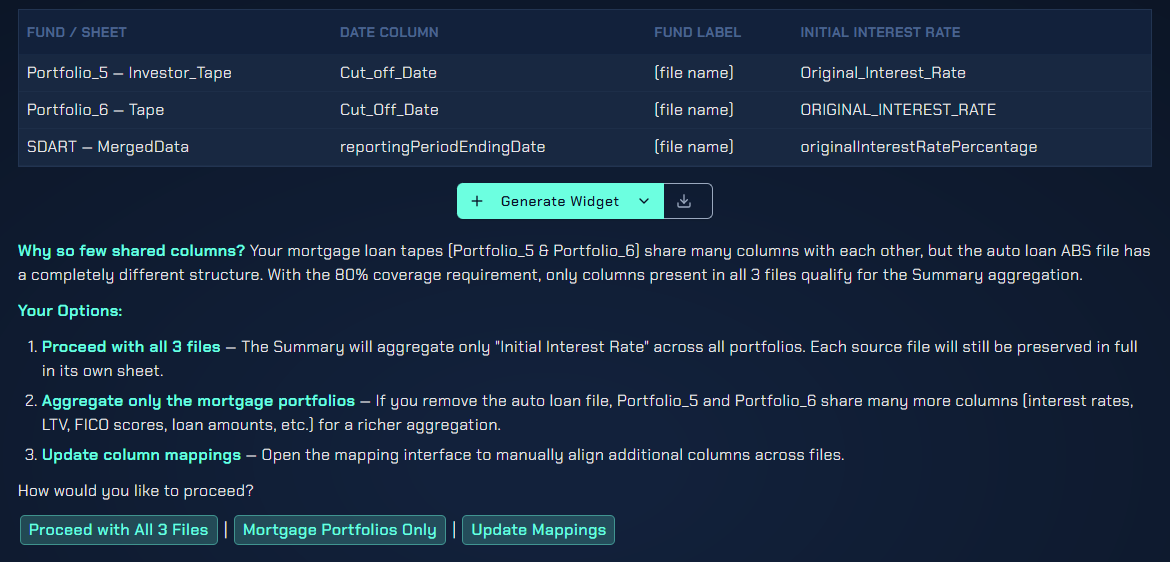 Schema Mapping
Why this problem is worse in financial services than almost anywhere else
Every institution accumulates its own dialect. A core banking platform, a trust accounting system, a handful of market data vendors, a document repository, a decade of M&A-inherited tools — each with its own naming conventions, its own units, its own assumptions about what a "position" or a "counterparty" or a "maturity date" actually represents. None of this was designed to agree with the others, because none of it was designed with the others in mind.
Layer AI agents on top of that without solving the translation problem, and you get a specific, dangerous failure mode: not an error message, but a confident wrong answer. An agent that treats notional in one system as equivalent to notional in another — when one is in local currency and the other in USD, or one includes accrued interest and the other doesn't — won't flag anything. It will just be wrong, fluently, in a report someone downstream trusts.
 Financial Data Translation
Data dictionaries: the semantic layer underneath the connectors
This is where Scalata's Data Marketplace does work that most integration tooling skips entirely. Every connector — REST, SOAP, database-native, MCP, whatever the source — feeds into a living data dictionary: a canonical definition of what each field means, what type and unit it holds, what business concept it maps to, and how it relates to the equivalent field everywhere else it appears across your systems.
The dictionary isn't a static spreadsheet somebody fills in once and forgets. It's built and maintained as connections are made, using the same agentic reasoning that reads an API's shape in the first place — inferring likely mappings from field names, sample values, and documentation, then surfacing those inferred mappings for a human to confirm rather than silently assuming they're correct. Where a mapping is ambiguous, it stays flagged as ambiguous until someone resolves it. Nothing gets promoted to "trusted" by default.
 Data Dictionaries
Schema mapping as governance, not just plumbing
This matters for a reason beyond convenience: a data dictionary is an audit artifact. When an agent pulls a "counterparty exposure" figure into a report, your risk and compliance teams can trace exactly which source field that number came from, what transformation was applied, and who approved that mapping. That traceability is what turns "the AI said so" into something a regulator, an auditor, or your own risk committee can actually stand behind.
It's also what makes the rest of the platform trustworthy. Your Knowledge Graph is only as coherent as the mappings feeding it — a graph that silently conflates two different definitions of "exposure" is worse than no graph at all, because it looks authoritative while being wrong. Table AI workflows that pull numbers across systems depend on those numbers meaning the same thing once they're side by side. None of that works without the mapping layer underneath it doing its job quietly and correctly.
Why we're telling you about the part nobody asks about
Most vendors lead with the flashy part — the chatbot, the automated report, the agent that "just works." Schema mapping and data dictionaries don't demo well. But they're the difference between an AI system that's impressive in a sales meeting and one you can actually rely on when a number in a report needs to hold up under scrutiny. Scalata treats this layer as core infrastructure, not an afterthought, because in financial services, the cost of getting it wrong isn't a bug ticket — it's a number someone made a decision on.
This is the third post in Scalata's Data Marketplace series. Next up: how all of this — connectors, models, and schema mapping — comes together in Knowledge Graph.
#DataGovernance #SchemaMapping #FinTech #AgenticAI #EnterpriseAI #Scalata