Perspective
Agentic Document AI: Reports That Manage Themselves
 Agentic Document AI: Reports That Manage Themselves
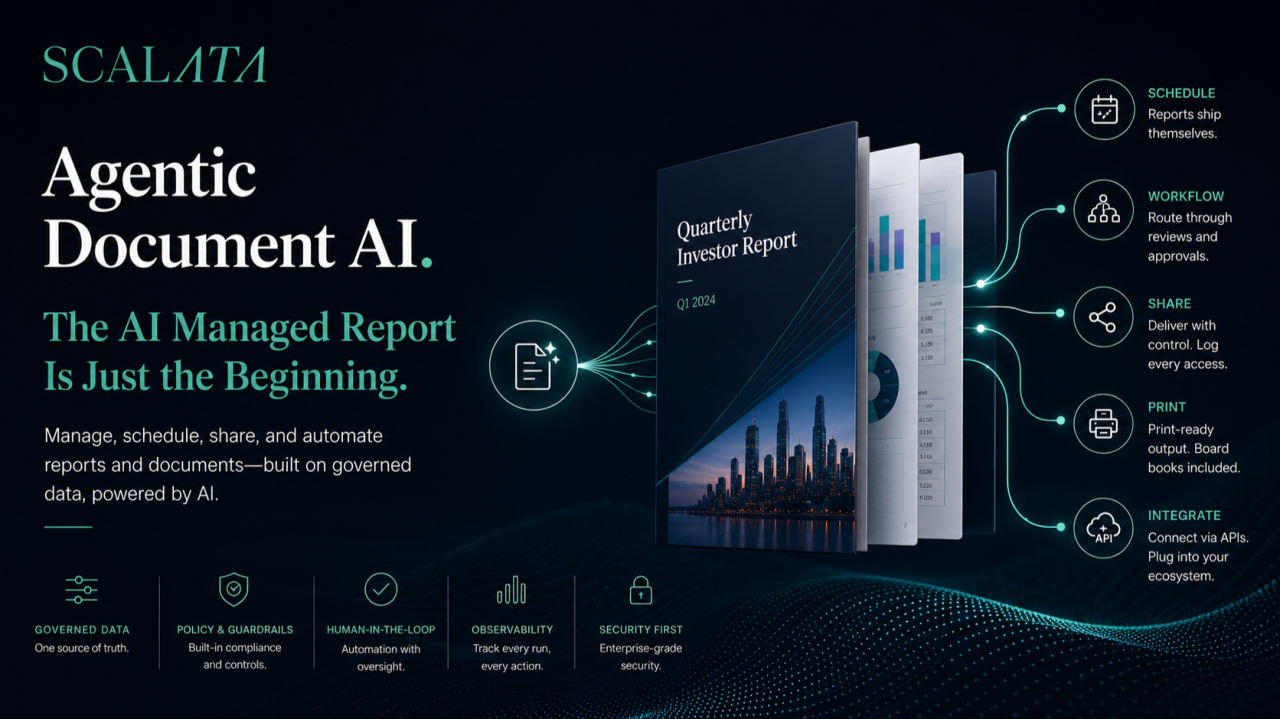
Agentic Document AI
Reports That Manage Themselves
Generating a great document, memo, or report solves only half the problem.
The other half is everything that happens afterward:
- Getting it to the right people
- Delivering it on the right schedule
- Formatting it correctly
- Routing it through approvals
- Sharing it without anyone remembering to press a button
This is where most document tools stop—and where Scalata's Document AI continues.
Every report produced on the platform is built from managed widgets: tables, charts, narrative blocks, and data panels that make up the document.
Because reports are structured objects rather than static files, everything downstream of generation becomes programmable, including:
- Distribution
- Scheduling
- Workflow routing
- Printing
- Integration with the systems your firm already uses
Sharing With Control, Not Attachments
 Governed Report Sharing
Reports on Scalata are shared as governed objects—not email attachments that immediately become multiple untracked copies.
You can share an entire report or an individual widget with:
- A person
- A team
- An external client or counterparty
Permissions stay attached to the object itself.
For example:
- A client can receive view-only access to their portfolio review.
- Your internal team can continue editing the underlying widgets.
Access can be:
- Time limited
- Instantly revoked
- Fully audited
Every view and download is logged.
Because widgets are shared by reference, everyone always sees the latest version.
When the underlying data refreshes, every authorized user automatically accesses the updated report.
No more asking:
"Which file is the latest?"
Scheduling: Reports That Ship Themselves
 Automated Report Scheduling
Recurring reports are among the most repetitive tasks in finance, yet many firms still prepare them manually.
With Scalata, any report becomes a scheduled deliverable.
Choose the cadence, including:
- Daily NAV summaries
- Weekly risk dashboards
- Monthly investor letters
- Quarterly board packages
The platform automatically:
- Regenerates the report using current data.
- Runs it through your configured human-in-the-loop workflow.
- Distributes it to the appropriate audience.
Schedules are calendar-aware.
Month-end reports automatically account for:
- Business days
- Market holidays
- Regional calendars
If a data feed is delayed or a validation check fails, the report is held automatically and the owner is notified.
The system never distributes a report built on incomplete or stale information simply because the scheduled time arrived.
Workflows: Routing Reports Through Your Process
 Workflow Automation and Report Approvals
Reports rarely move directly from generation to delivery.
Instead, they follow a review process.
Scalata's Workflow Builder allows firms to encode those processes directly into the platform.
For example, an investor letter might automatically route through:
- Portfolio Manager review
- Compliance approval
- Client Services distribution
Every step is:
- Tracked
- Recorded
- Auditable
Escalation rules automatically notify stakeholders if an approval stalls.
Workflows can also branch dynamically based on report content.
For example:
- A report identifying a covenant breach can immediately route to the credit team with elevated priority.
- A report without issues continues through the standard approval process.
Policy and Guardrail Engines ensure that no required review step is skipped, even during high-pressure reporting deadlines.
Printing: Because Paper Hasn't Left the Building
Board meetings, deal closings, and regulatory submissions continue to rely on printed documents.
Document AI produces print-optimized reports automatically, including:
- Proper pagination
- Print-safe margins
- Headers and footers with document control numbers
- High-resolution charts and tables
Widgets intelligently reflow for print.
A table that scrolls horizontally on screen becomes properly paginated on paper instead of being truncated.
Batch printing supports complete board books with:
- Cover pages
- Section tabs
- Automatically generated tables of contents
API Connections: Reports as Infrastructure
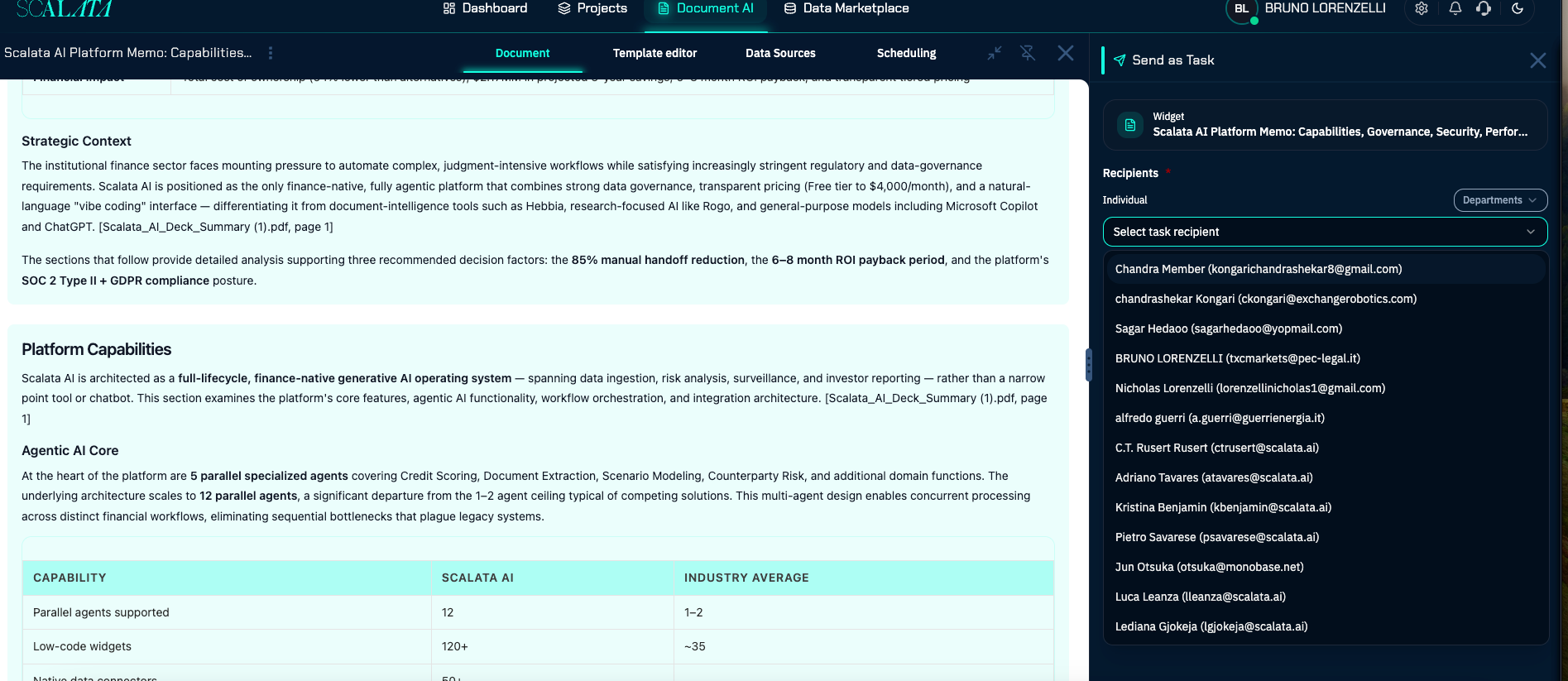 Reports Connected Across Enterprise Systems
For organizations treating reporting as infrastructure rather than individual documents, every capability is available through APIs.
Scalata can trigger report generation automatically from business events such as:
- A trade settling
- A file arriving
- A threshold being exceeded
Widgets can retrieve live information from internal systems and external data providers through governed connections.
Completed reports can then be delivered directly to:
- Client portals
- Document management systems
- CRMs
- Data rooms
Reporting becomes part of the operating stack itself.
Business systems generate events.
Scalata converts those events into governed documents.
Distribution channels deliver them automatically.
Humans remain involved only where organizational policies require approval.
Reporting as a System, Not a Scramble
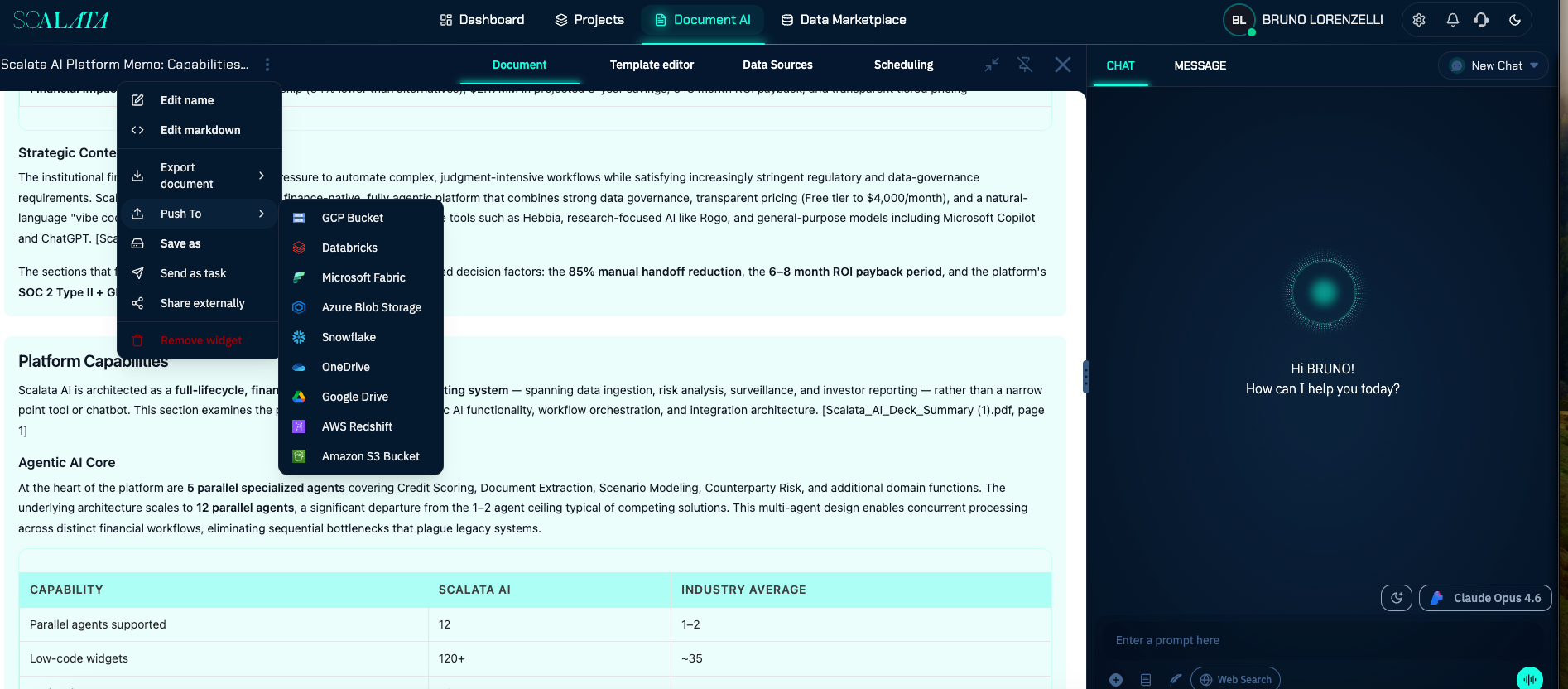 Reporting Operations Instead of Reporting Projects
Each capability saves time individually.
Together, they fundamentally change how reporting works.
Instead of becoming a recurring monthly scramble, reporting becomes:
- Observable
- Governed
- Automated
- Self-operating
Your team's role shifts from manually producing reports to supervising an intelligent reporting operation.
That creates a better workflow—and ultimately, better reporting.
Scalata is the finance-native agentic AI platform for institutional markets.
See Document AI in action at scalata.ai.