Perspective
Mapping the Work: How a Workforce Graph Handles Tasks, Handoffs, and the Messy Middle
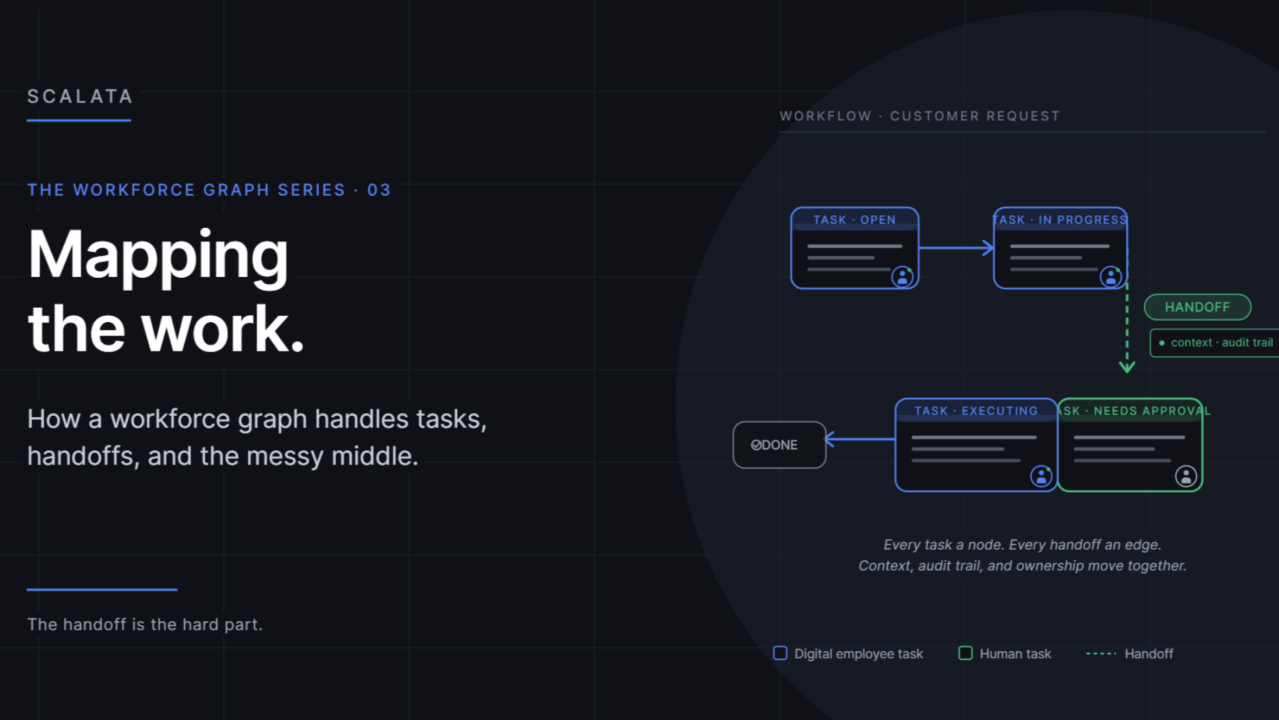 Mapping the Work
Mapping the Work
How a Workforce Graph Handles Tasks, Handoffs, and the Messy Middle
Most conversations about AI in the enterprise jump straight to the exciting part: the agent doing the work.
What gets skipped is the boring—but decisive—part: how the work gets to the agent in the first place, and what happens after.
Work doesn't live in isolation.
It lives in workflows: chains of tasks with triggers, dependencies, handoffs, and escalations.
If your digital employee is brilliant at its job but can't plug into those chains, you haven't added a worker.
You've added an island.
And the cost of that island is higher than it looks, because every piece of work that touches it now requires a human translator to move it in and out.
This is the problem the Scalata workforce graph is built to solve.
Not "how do we make the agent smarter?"—that's a model problem, and model providers are already solving it.
The real challenge is:
How does the agent become part of the machinery of the business?
Tasks and Workflows as First-Class Nodes
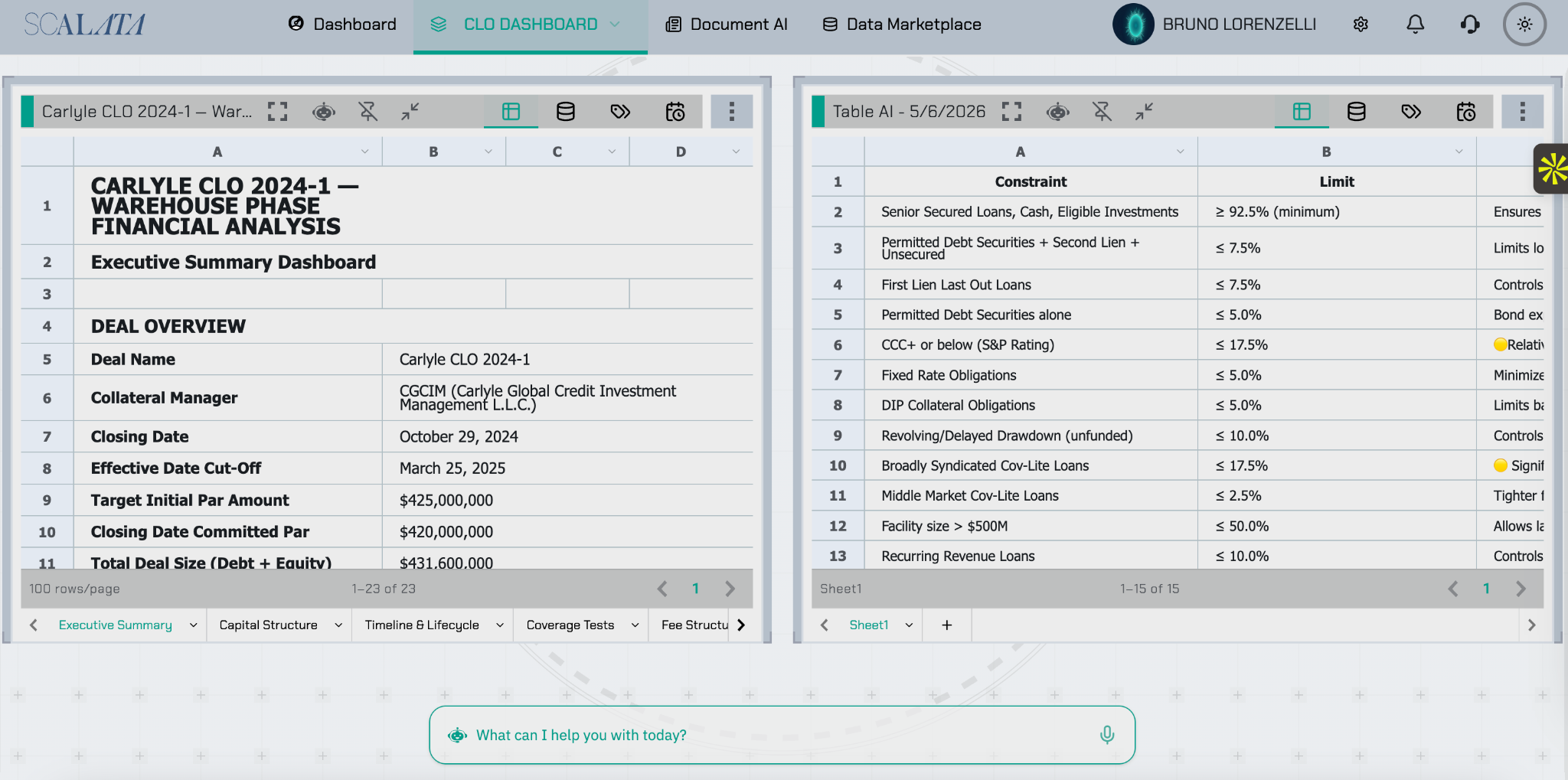 Tasks and Workflows
In Scalata, a task isn't simply a row inside a ticketing system.
It's a node in the workforce graph connected to everything that matters:
- Who created it
- Who owns it
- What it depends on
- What it triggers
- Which tools it touches
- Its definition of done
- Priority
- Time open
- Business context
A workflow is a structured collection of those task nodes connected through edges that define sequencing and conditions.
For example:
When X happens, create task Y, assign it to node Z, and block task W until task Y is complete.
The workflow isn't documentation sitting inside a wiki.
It is a live object inside the graph that both humans and digital employees actively participate in.
When the workflow changes, every participant immediately operates under the updated structure.
Because tasks and workflows exist inside the same graph as people and digital employees, assigning work becomes dramatically simpler.
The graph already knows:
- Who is qualified
- Who is available
- Who has the appropriate permissions
- Who typically performs similar work
Routing work stops becoming a human decision repeated thousands of times every day.
It becomes a property of the system itself.
Managers spend less time triaging work.
Team leads stop chasing status updates.
The system handles both automatically.
This isn't simply operational efficiency.
It represents a fundamentally different way work moves throughout an organization.
The Handoff Is the Hard Part
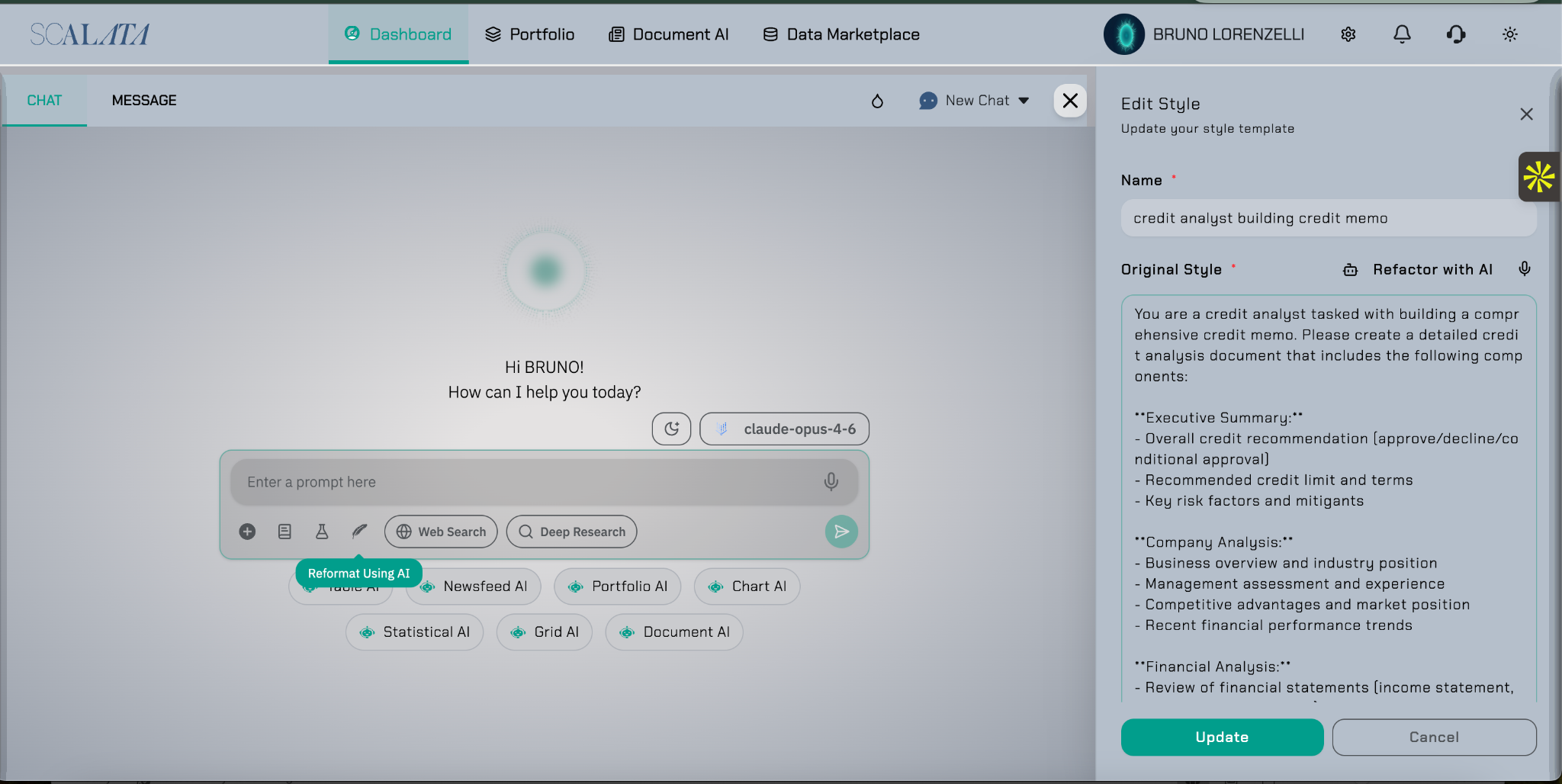 Task Routing
If you've ever watched work fail inside an organization, you've almost certainly watched a handoff fail.
Examples include:
- Sales closes the deal but implementation isn't notified.
- A support ticket is resolved but the customer never hears about it.
- A report is produced after the stakeholder has already moved on.
- HR finishes hiring but IT never provisions a laptop.
Handoffs are where information gets dropped.
They're also where most digital employee deployments fail.
A great AI agent that cannot cleanly hand work to a human—and receive work back—is often worse than no AI agent at all.
When a human misses a handoff, other humans usually notice.
When an AI misses one, it can remain invisible for weeks.
A workforce graph treats every handoff as a semantic relationship.
It knows:
- Who is handing work to whom
- What context accompanies the work
- What state the work should be in
- What happens if the recipient is unavailable
When a digital employee finishes its work and hands it to a human, the context arrives automatically.
No reconstruction.
No catching up.
No searching through chat history.
The graph itself is the shared state.
This fundamentally changes collaboration.
Instead of deciphering what the AI already did, the human immediately sees:
- The original request
- Completed work
- Decisions made
- Remaining decisions
- Outstanding blockers
The handoff becomes a continuation rather than an investigation.
The same process works in reverse.
When a human hands work to a digital employee, the AI receives the identical structured context.
It doesn't have to infer intent.
The graph carries intent, history, and state together.
Escalation, by Construction
The same structure also governs escalation.
Every node inside the graph already knows:
- Which manager owns it
- Which team owns the workflow
- The appropriate on-call rotation
- Fallback paths when primary owners are unavailable
When a digital employee encounters something outside its capabilities—whether a policy exception, ambiguous customer request, or permission boundary—it doesn't guess.
It follows an edge.
The graph routes the work to the correct human, complete with full context and an explanation of why the escalation occurred.
This is governance in practice.
Not documentation describing escalation rules.
A graph where escalation paths are explicit, visible, auditable, and centrally managed.
Updating governance becomes as simple as updating the graph.
Every connected digital employee immediately follows the new policy.
For regulated industries, this capability is essential.
For every other industry, it enables organizations to deploy AI confidently rather than cautiously.
The Compounding Effect
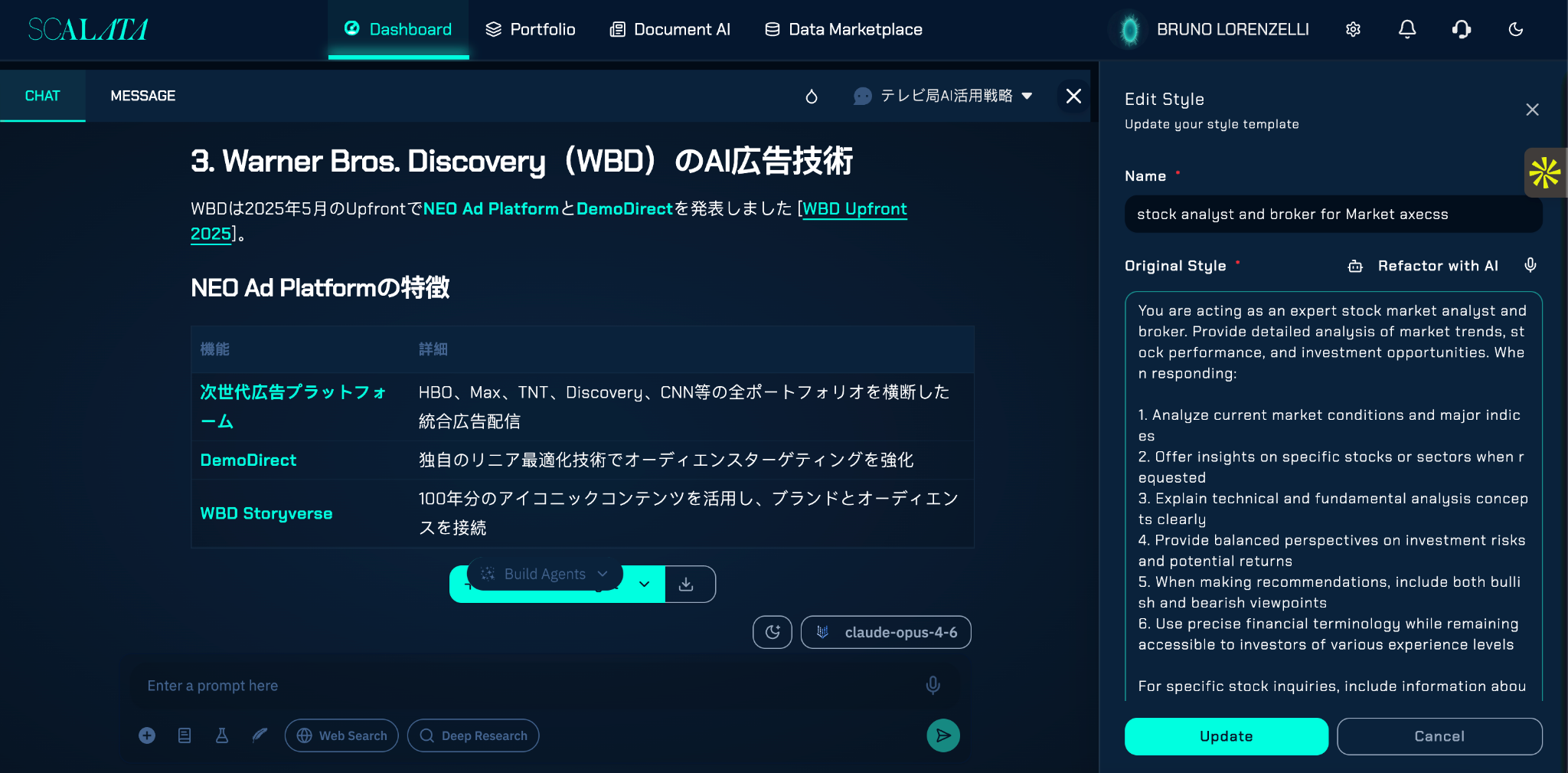 Escalation Workflows
The graph improves continuously.
Every completed task.
Every successful handoff.
Every escalation.
Leaves behind structured knowledge.
Over time, organizations are no longer simply operating the workforce.
They're observing it.
And observation at scale becomes insight.
Organizations discover:
- Which workflows people actually follow
- Which workflows employees routinely bypass
- Which handoffs introduce delays
- Where digital employees should assume more responsibility
- Which humans remain bottlenecks
- Where automation opportunities actually exist
The graph also reveals unexpected patterns.
For example:
- A workflow that always escalates to one person may indicate that person's expertise should become automated.
- A task with consistently high rework rates may expose poor upstream instructions.
- A digital employee with rising escalation frequency may indicate changing data distributions requiring retraining.
These insights are nearly impossible to extract from spreadsheets or ticketing systems.
They emerge naturally from a graph.
Analytics are no longer a separate product.
They become an inherent property of the operating model.
How Scalata Handles This Differently
Workflow tools already exist everywhere.
Most enterprises already use several:
- Ticketing systems
- Process automation platforms
- iPaaS tools
- RPA platforms
- Agent vendors
So why does Scalata exist?
Because none of those systems were designed for hybrid work—where humans and digital employees exchange work continuously under regulatory oversight.
Scalata differentiates itself in several ways.
Handoff Context Is Preserved as a Regulated Artifact
When a Scalata digital employee hands work to a human, every input, intermediate decision, tool interaction, and accessed dataset becomes part of the structured task record.
Rather than preserving a chat transcript, Scalata preserves an audit-grade workforce record.
Escalations Enforce Policy, Not Preference
Escalation paths exist inside the graph itself.
If policy requires finance approval for refunds above a defined threshold, the digital employee literally cannot bypass that edge.
Governance becomes structural.
Workflows Are Versioned and Auditable
Compliance teams often need to reconstruct historical processes.
Scalata versions every workflow.
Organizations can answer questions such as:
What exactly did this workflow look like six months ago?
Most workflow systems cannot.
Cross-Workflow Analytics Are Native
Scalata answers questions across the entire organization:
- Which workflows affected which customers?
- Which digital employees worked on regulated transactions?
- How did data move across multiple operational processes?
One Substrate for Humans and Digital Employees
Traditional systems assume either humans or automation.
Scalata assumes both.
Humans and digital employees occupy identical roles inside workflows.
Switching between them becomes configuration—not redevelopment.
Defensible by Design
When something goes wrong, organizations must explain:
- What happened
- Why it happened
- How it was handled
Scalata's workforce graph makes those answers immediately available.
Many consumer-first agent platforms struggle to provide equivalent evidence.
These differences explain why Scalata succeeds in enterprise environments where compliance officers, CISOs, and legal teams participate directly in purchasing decisions.
The Point
A digital employee is only as useful as the workflow surrounding it.
A world-class AI operating inside a broken workflow still produces outputs nobody can use.
A capable AI inside a well-designed workflow produces reliable, auditable, and compounding value.
The workflow is where the leverage exists.
Build the workforce graph first.
The agents naturally become members of the organization.
Bolt AI onto disconnected systems afterward, and organizations spend years cleaning up fragmented ownership, duplicated workflows, forgotten automations, and inconsistent governance.
We've seen enough organizations attempt both approaches to know which one scales.
Next in this series: What it actually means to build a person-agent and attach it to a node in the graph—identity, skills, permissions, relationships, and the anatomy of a digital employee that behaves like a real member of your team.