Perspective
Boring AI Interfaces: Why Every Competitor Looks the Same — And How Scalata Breaks the Mold
 Boring AI Interfaces
: Why Every Competitor Looks the Same — And How Scalata Breaks the Mold
1. Introduction: Why AI Interfaces Are Stuck in 2022
Imagine starting every monthly review the same way: opening a new chat, explaining the reporting rules again, and reformatting the result for your team. The answer comes back faster. The work around it still feels familiar.
That's the state of AI interfaces in 2026.
The models have exploded in capability. OpenAI's GPT models, Claude, and Gemini can work across different types of media, and AI agents can handle increasingly complex tasks.
But the text box is still a familiar starting point.
Open Rogo, Hebbia, Claude, ChatGPT, Auquan, F2, or AlphaSense. Their interfaces and features differ, but the query-and-response loop is still familiar. You ask a question, review the output, and refine your request. For recurring tasks, that can mean repeating the same setup tomorrow.
The industry has collectively failed at interface, data management, and customer innovation.
We've poured billions into making AI smarter while leaving users trapped in the same monotonous interaction patterns. Same commute. Same desk. Same tasks. The technology evolved; the experience didn't.
Here's the uncomfortable truth: these tools aren't built for you. They're built for firms, for enterprises, for the lowest common denominator of "user." You don't personalize them. You don't build with them. You consume what they give you — and what they give everyone else.
This blog is a challenge to the status quo. We're going to tear down the industry's biggest names, expose why their interfaces have stagnated, and show you what happens when someone finally decides to build differently.
2. The Sameness Problem: Personalization, Workflows, and Apps
A recurring analysis often starts with the same sources, instructions, and output format. When those choices live in a single conversation, the analyst may have to recreate them each time the work comes up.
Three questions help separate the platforms: how much can you personalize, what can you automate, and what can you build yourself?
The Personalization Myth
Rogo emphasizes financial agents that teams can use across a firm. Hebbia's Matrix gives analysts a structured table for comparing documents. Both approaches make it easier to standardize work, while raising the question of what an individual analyst can tailor.
These platforms personalize at the firm level, not the user level. Your workflow, your preferences, your unique way of thinking about a problem? Irrelevant. You get the same interface as everyone else in your organization. And everyone at the competing firm across the street.
It's like being handed a corporate uniform and told it's "custom" because it has your company logo on it.
The Workflow Void
Think about how you actually work. You have processes. Shortcuts. Mental models you've developed over years of experience. Now think about the last time an AI tool adapted to any of that.
Auquan produces ready-to-review outputs, and F2's Adam helps create investment committee memos. The practical question is how easily you can adjust those workflows to match the way your team reviews a deal.
It's the same commute, the same desk, the same tasks — day after day. The tools never learn your rhythm. They just expect you to learn theirs.
The App-Building Impossibility
Creating a custom app takes a different set of capabilities from running an existing workflow. The team may need to define its own screens, inputs, and review steps.
You can't create a custom tool for your specific analysis workflow. You can't spin up a purpose-built application for that recurring task you do every Monday. You're a consumer of pre-built solutions, never a creator of your own.
ChatGPT's Custom GPTs let users package instructions and capabilities for reuse. A dedicated application adds another layer of design, including the interface people use and how the application handles recurring work.
The result? Millions of professionals using AI tools that feel exactly the same, producing outputs that look exactly the same, trapped in interfaces that refuse to evolve.
3. Rogo & Hebbia: Smart Under the Hood, Boring on the Surface
Let's give credit where it's due: Rogo and Hebbia are technically impressive. They've raised serious money from serious investors. They process trillions of tokens. They serve firms managing $30 trillion in assets. The engineering is solid.
But here's the uncomfortable truth: they built powerful engines and forgot to design the car.
Rogo: An "Operating System" You Can't Actually Operate
 Rogo
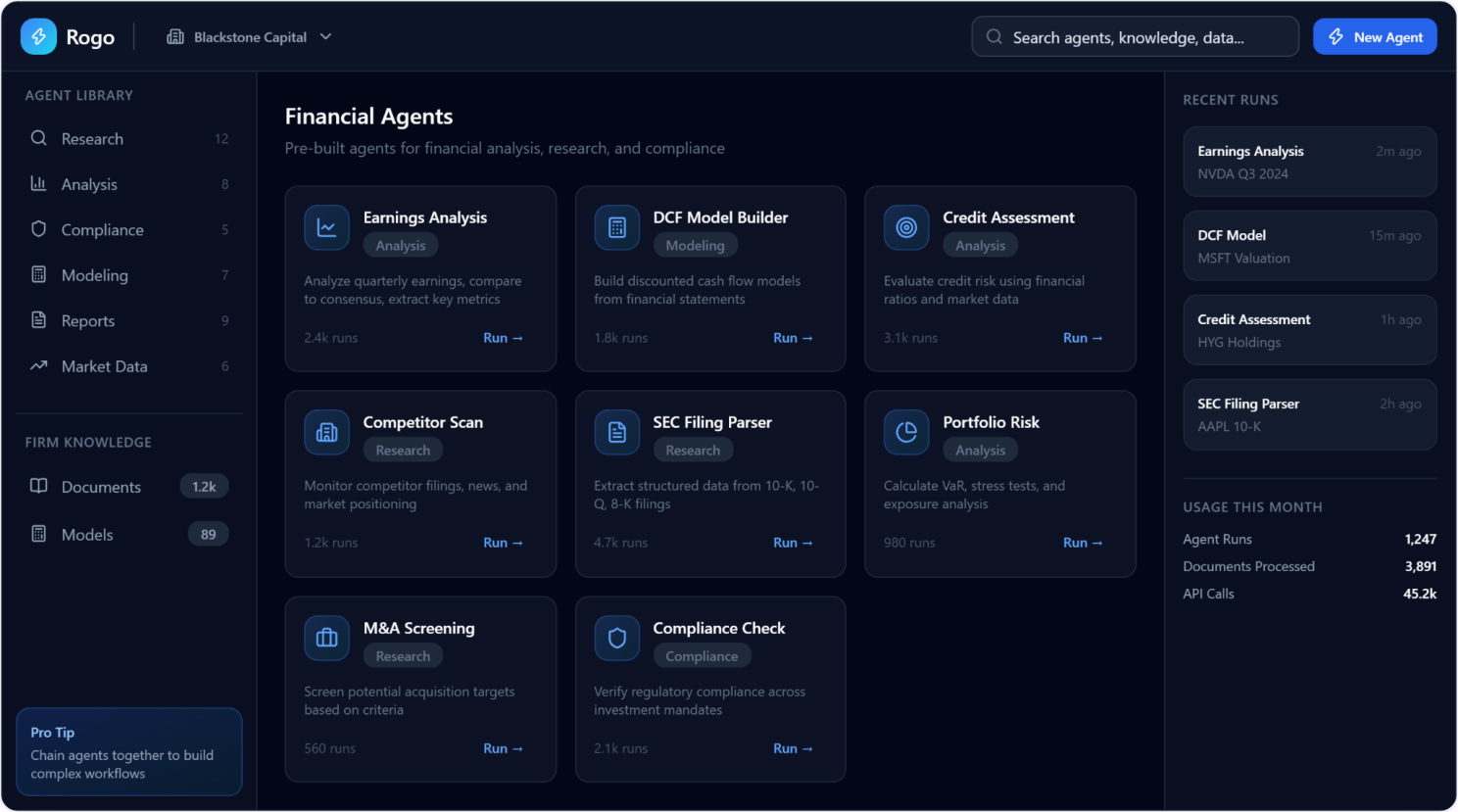
Rogo positions itself as the "operating system for finance," with purpose-built agents that help teams carry out recurring financial work.
The platform offers hundreds of financial agents for end-to-end workflows. For an analyst, the question is how far those workflows can be tailored to a specific team or task.
Rogo talks about "institutional memory" and "firm knowledge capture" — which is great for the institution, but what about your memory? Your workflow? The platform captures firm-level intelligence while leaving individual users to adapt themselves to pre-defined agents.
Hebbia: The Spreadsheet That Ate AI
 Hebbia
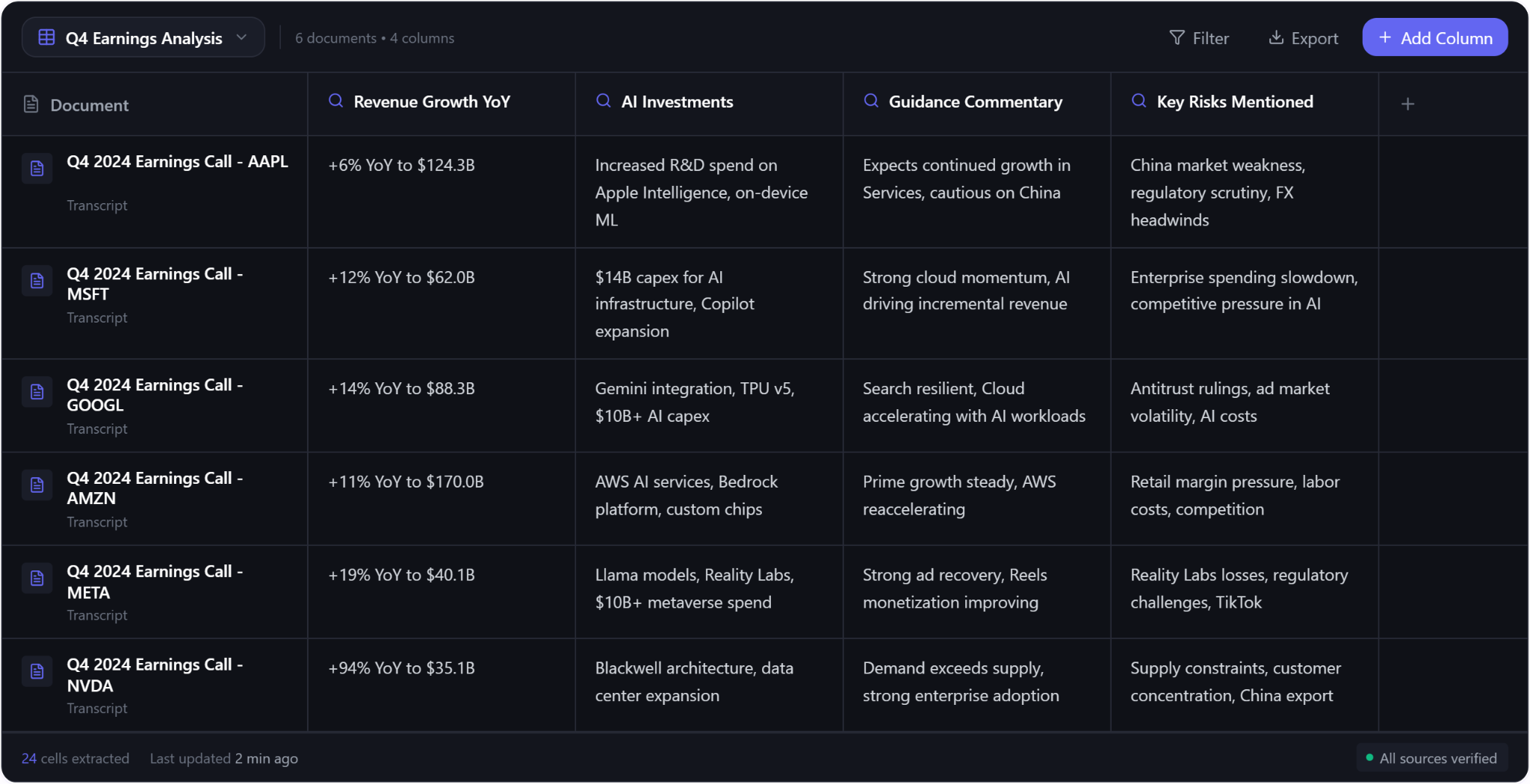
's Matrix uses a spreadsheet-like interface to extract and compare information across documents. Hebbia also offers Max.
What Hebbia Does Well
- Document analysis at scale
- Structured data extraction
- Enterprise security features
- Comparison across documents
What to Evaluate
- How results feed into a custom app
- How analysts tailor the review process
- What users can see about model use
- How teams reuse and adapt workflows
Matrix is essentially a sophisticated query tool. You ask questions, it fills in cells. You query, you don't build. The interface shows financial metrics in tidy table formats — functional, efficient, and utterly generic.
The Common Thread
Both Rogo and Hebbia made the same fundamental mistake: they optimized for enterprise deployment over individual empowerment. They built platforms that scale across institutions while treating every user within those institutions as interchangeable.
Smart under the hood. Boring on the surface. Impersonal at the core.
4. Auquan & F2: Data In, Same Data Out
Here's a thought experiment: imagine two analysts at different firms. One covers distressed debt in Latin America. The other focuses on investment-grade corporate bonds in the Nordics. They have completely different investment theses, risk tolerances, and information needs.
Both may want a consistent report, but the fields, sources, and escalation criteria that matter to each analyst can differ.
This is the standardized output problem — and it's quietly undermining the entire value proposition of AI in finance.
Auquan: Pre-Baked Workflows for Everyone
 Auquan
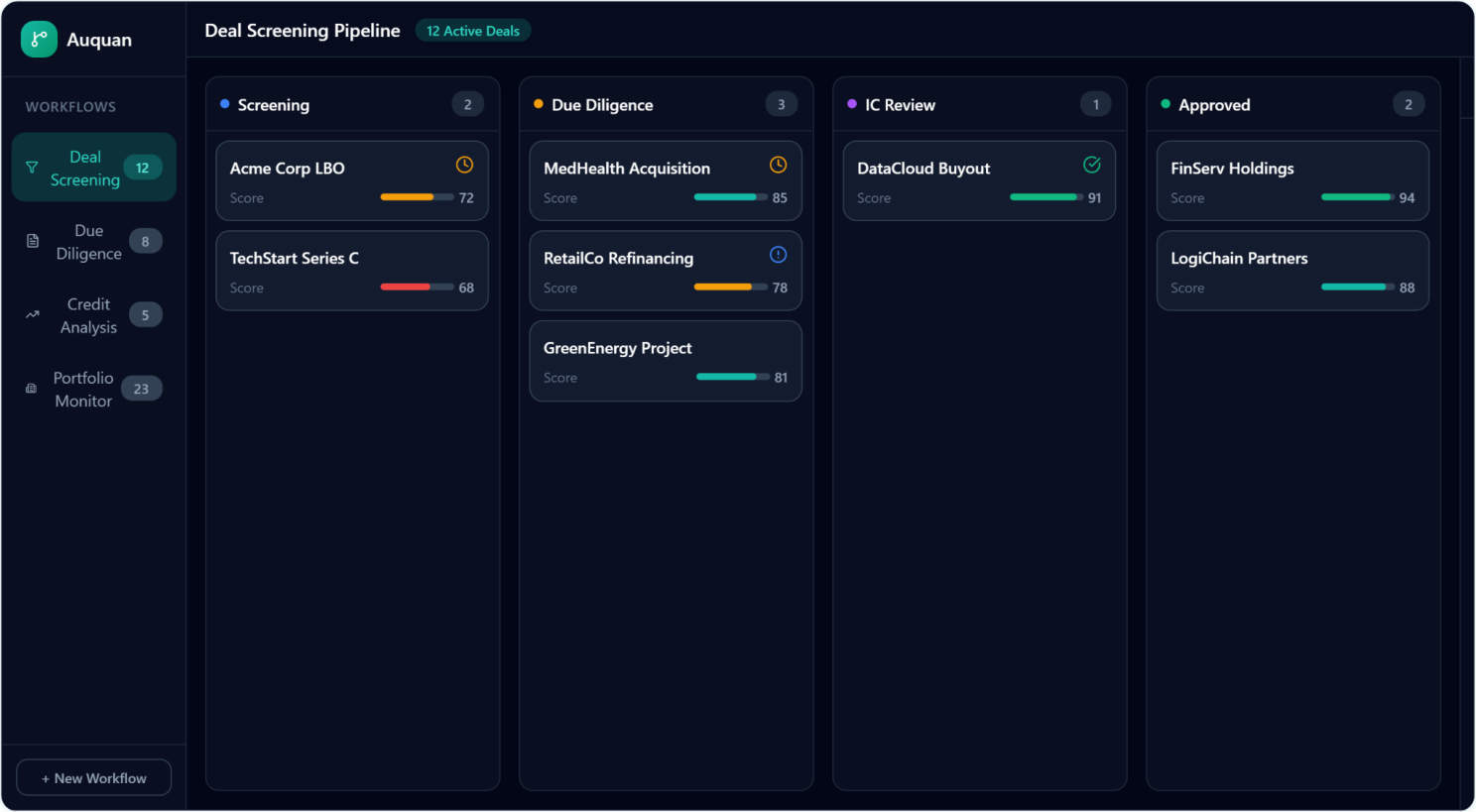
 positions its agentic workflows around cutting the time spent on multi-day tasks such as deal screening.
But here's what they don't advertise: those workflows are pre-built. You're not creating your own analytical framework — you're fitting your process into their template.
Auquan's Focus
- Review-ready reports
- Research across sources
- Agentic workflows
- Time saved on preparation
What to Evaluate
- How reviewers confirm or correct a finding
- How the workflow handles missing evidence
- How teams can adapt the workflow
- Where manual review still fits
Auquan's emphasis on ready-to-review outputs is useful when the team already knows what its deliverable should contain.
One telling detail: customer feedback mentions "dealing with a lot of false positives and false negatives" as a pain point before using the platform. The solution? Standardized workflows that reduce noise. But standardization is a blunt instrument when what you actually need is precision tailored to your specific mandate.
F2: Meet Adam, the Credit Deal Agent
 F2
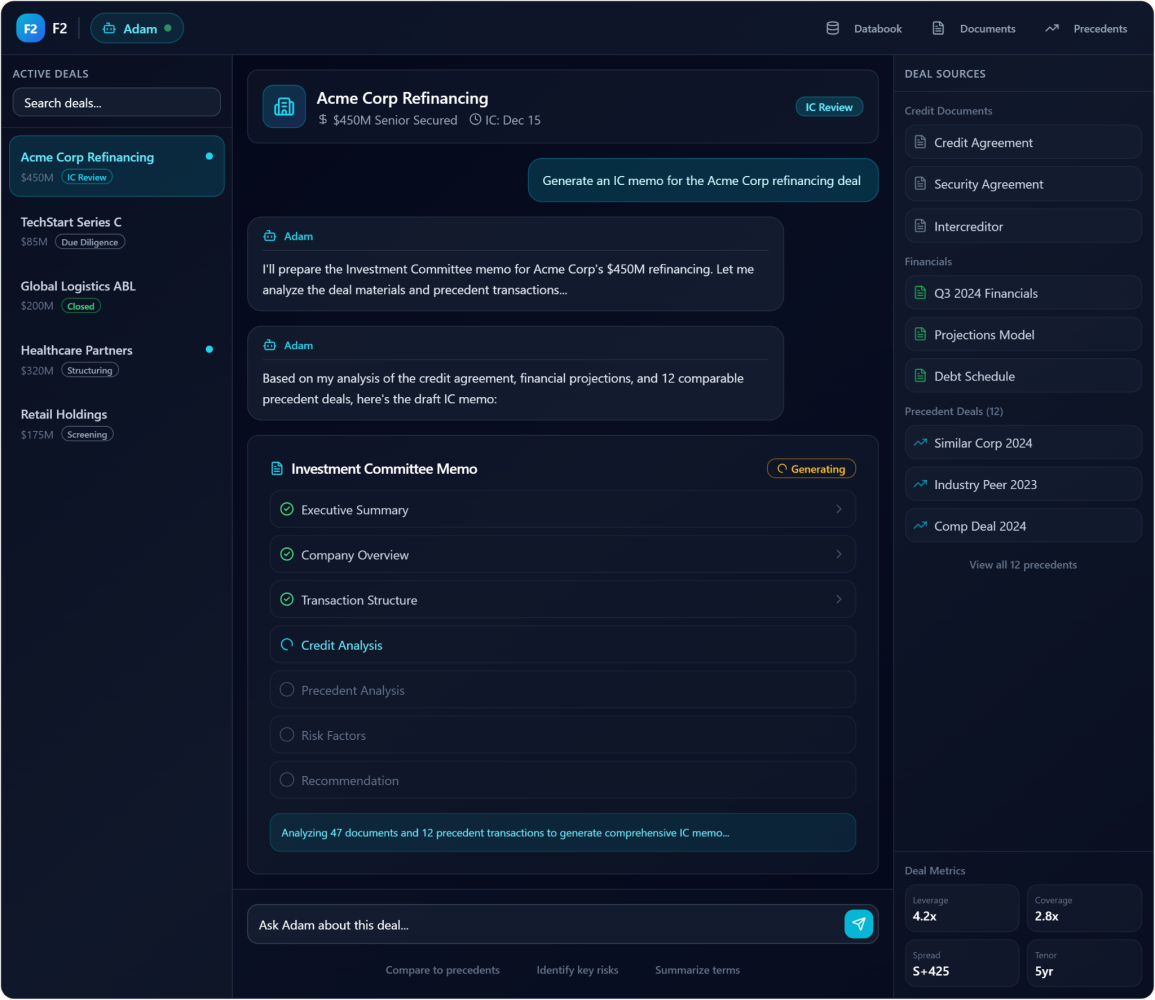
F2 introduces "Adam" — their autonomous deal agent that creates IC memos, searches precedent deals, and builds databooks. The pitch is compelling: "Every new deal still starts from scratch. Until F2."
F2 also describes configuring workflows around a firm's existing processes. A team evaluating Adam should ask what it can change itself when a deal falls outside its usual process.
F2 claims to be "model agnostic" and "multi-model" — positioning against single-model competitors. Great. But which model is handling your specific query? When does it switch? What's the logic?
Model flexibility and visibility into how a particular task runs are separate questions.
For an investment committee memo, that means checking how the team can change the format, challenge an assumption, or trace a finding back to the supporting material.
The Core Problem: Assembly Line AI
Both Auquan and F2 treat financial analysis like a factory floor. Raw data goes in one end. Polished reports come out the other. The machinery in the middle is impressive, well-oiled, and completely indifferent to who's standing at the receiving end.
This works for commoditized tasks. It fails catastrophically for anything requiring judgment, context, or — here's a radical concept — your perspective on the data.
Data in, same data out. Every time.
5. Claude & ChatGPT: The Chat Box Trap
Claude and ChatGPT both start from a familiar conversational interface, and both can do more than answer questions in a text box.
Claude and ChatGPT can reason across complex tasks, work with tools, and help users build outputs they can use elsewhere.
When Conversations Become Recurring Work
 When Conversations Become Recurring Work
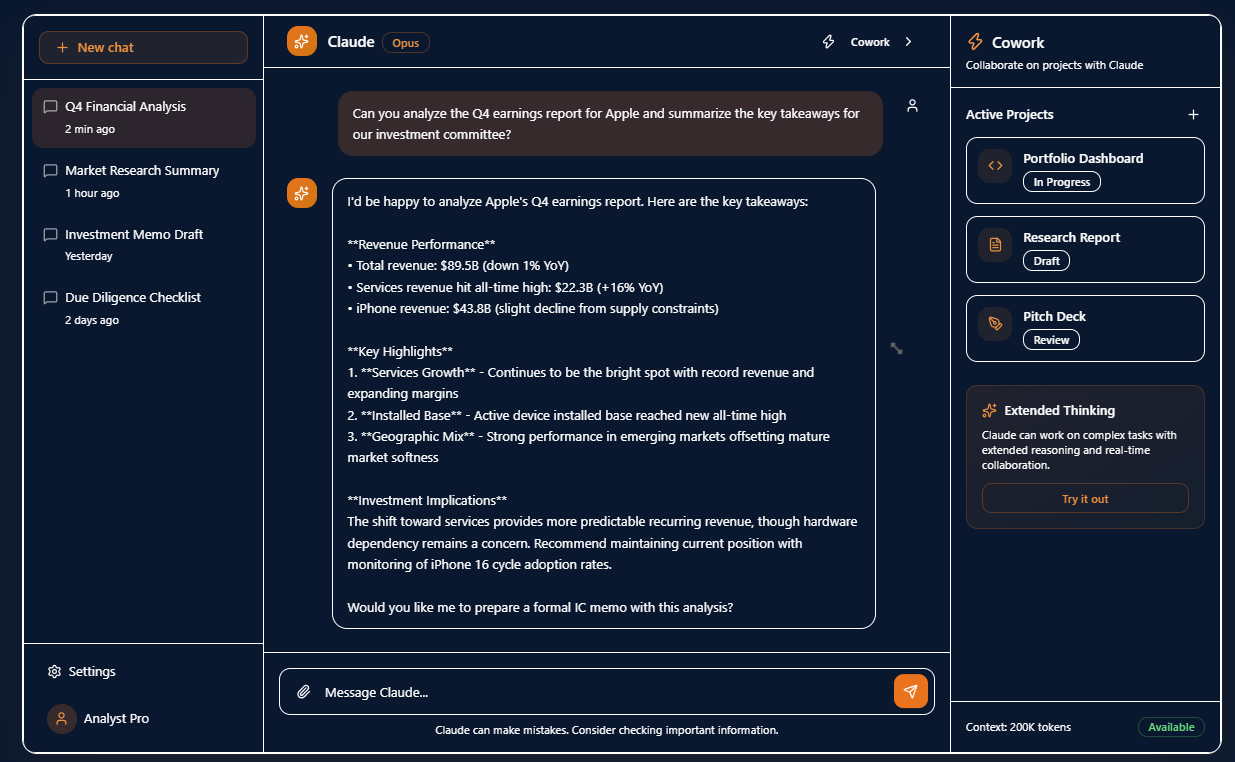
A common interaction still follows a familiar pattern. You ask a question, get a response, and refine it. For recurring work, it helps to save the instructions, sources, and review criteria so the next run starts with the same context.
Claude's Cowork capabilities can work across files and connected tools, carry out multistep tasks, and schedule recurring work. Claude Cowork
Custom GPTs and Apps
 Custom GPTs and Apps
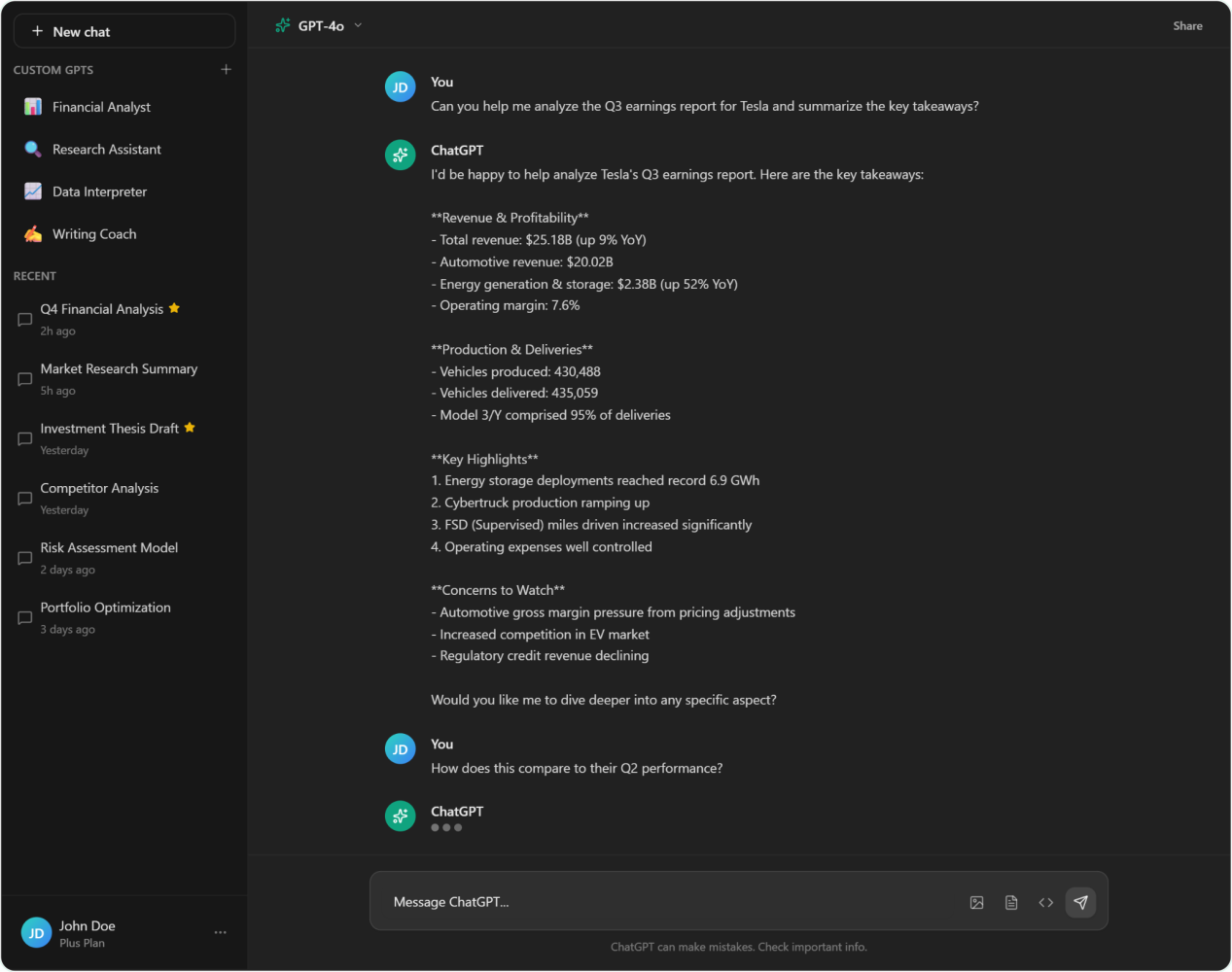
Custom GPTs give ChatGPT users a way to reuse instructions and configured capabilities.
ChatGPT also supports interactive apps, and OpenAI provides an Apps SDK for developers building those experiences.
For a finance team, the useful question is whether it needs a reusable assistant, an app people can interact with, or a workflow that runs on a schedule. OpenAI Apps SDK
What a Recurring Workflow Needs
When comparing Claude and ChatGPT with a platform designed for your recurring work, ask about:
- How teams save and update workflow instructions
- How teams create and share a tailored app
- What teams can see about the models involved
- What code or logic a reviewer can inspect
A conversation can be an effective starting point. For recurring work, the test is how easily the team can reuse, revise, and review what it builds.
6. AlphaSense: Clunky Meets Legacy
 AlphaSense
If the previous competitors represent the present-day stagnation of AI interfaces, AlphaSense represents something even more troubling: the past refusing to let go.
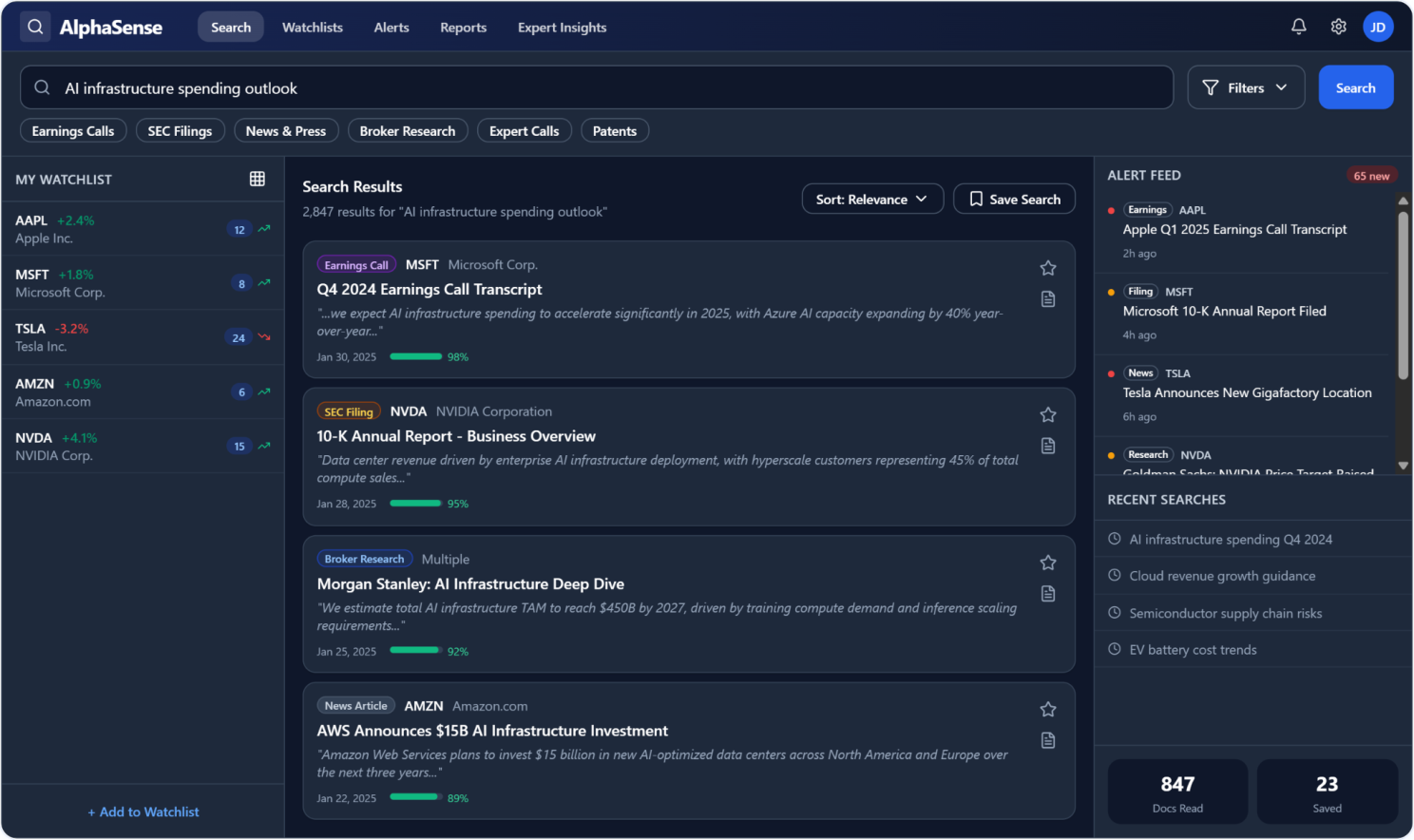
Founded in 2011, AlphaSense grew out of enterprise search and now combines market intelligence, research, and AI-assisted workflows.
The Legacy Tax
Here's what happens when a pre-AI company tries to become an AI company: you get dashboards. Lots of dashboards. You get "Monitoring" tools. You get "Workflow Agents" that sound cutting-edge but feel like navigating a corporate intranet from 2015.
Enterprise-First, User-Last
The AlphaSense experience is designed for procurement committees, not actual users. Their "SuperAnalyst" and "Deep Research" features might impress in a sales demo, but the day-to-day reality is clunky navigation, rigid workflows, and interfaces that fight against you rather than enable you.
Legacy Indicator & What It Means for Users
- Founded 2011 -> Architecture predates modern AI paradigms
- AI research tools -> Analysts can gather and synthesize evidence in the platform
- Enterprise-first design -> Individual user needs are secondary
- Dashboard-heavy UI -> Navigation complexity over simplicity
Unified research can make it easier to find information across sources. Teams should also consider where the resulting analysis goes next, especially when it feeds a custom review or reporting process.
The Clunk Factor
Every interaction with legacy enterprise software carries what we might call a "clunk factor" — that moment of friction where the interface demands you adapt to it, rather than adapting to you. AlphaSense has industrialized clunk. Excel integrations. PowerPoint exports. Monitoring dashboards that require training sessions to understand.
This is what happens when AI becomes a feature rather than a foundation. The underlying architecture was built for a different era, and no amount of "Generative Search" marketing can change the fundamental user experience.
The Forrester Wave named them a Leader in Market & Competitive Intelligence Platforms. But being the best at an outdated paradigm isn't the same as innovation. It's just polished legacy.
7. The Scalata Way: Build Your Perfect App in 5 Minutes
 The Scalata Way
Here's where the script flips.
What if you didn't have to adapt yourself to the tool? What if the tool adapted to you?
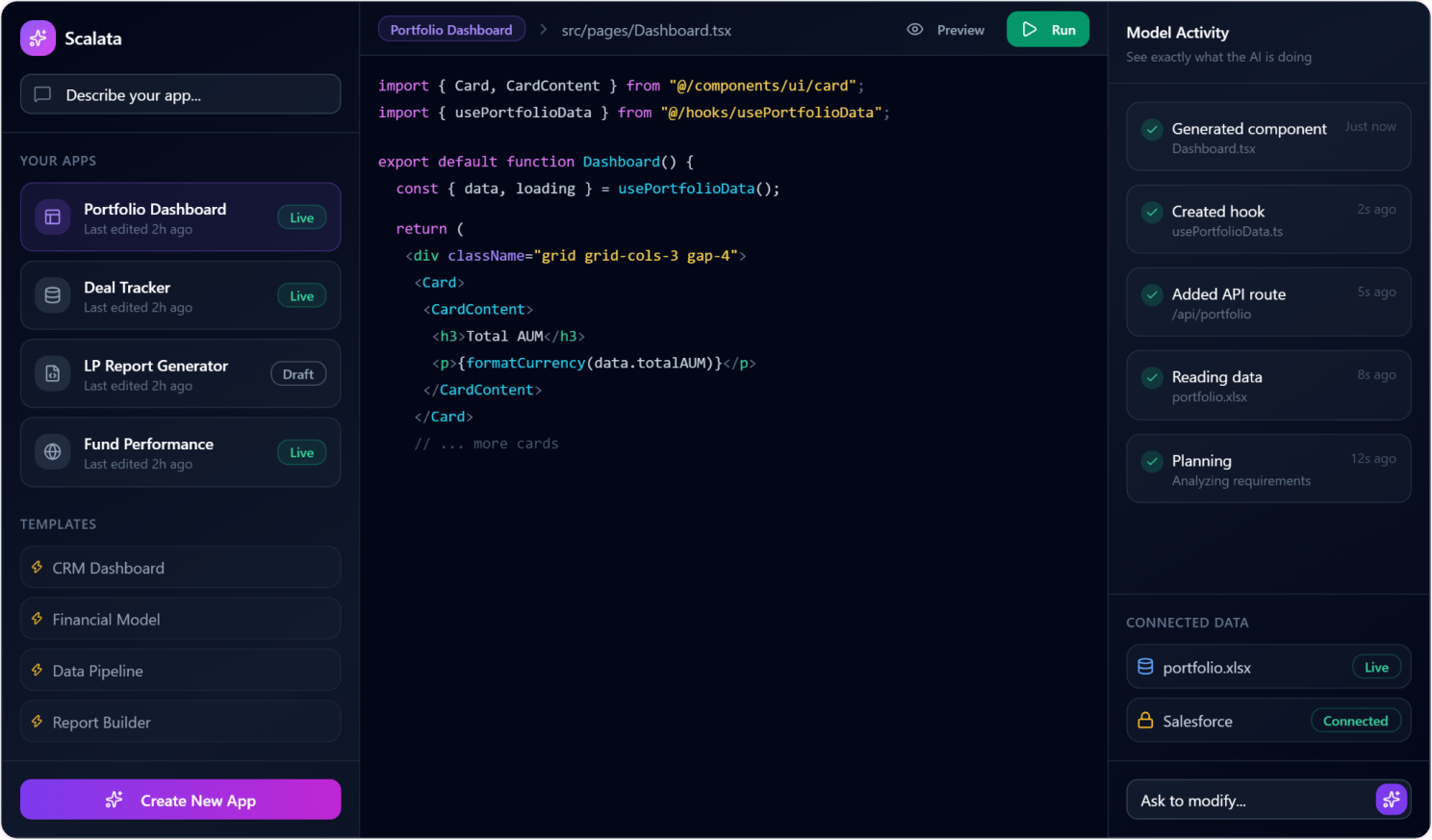
Scalata isn't another chat box. It isn't another pre-built agent you're forced to accept. It's a platform where you become the builder.
From Consumer to Creator
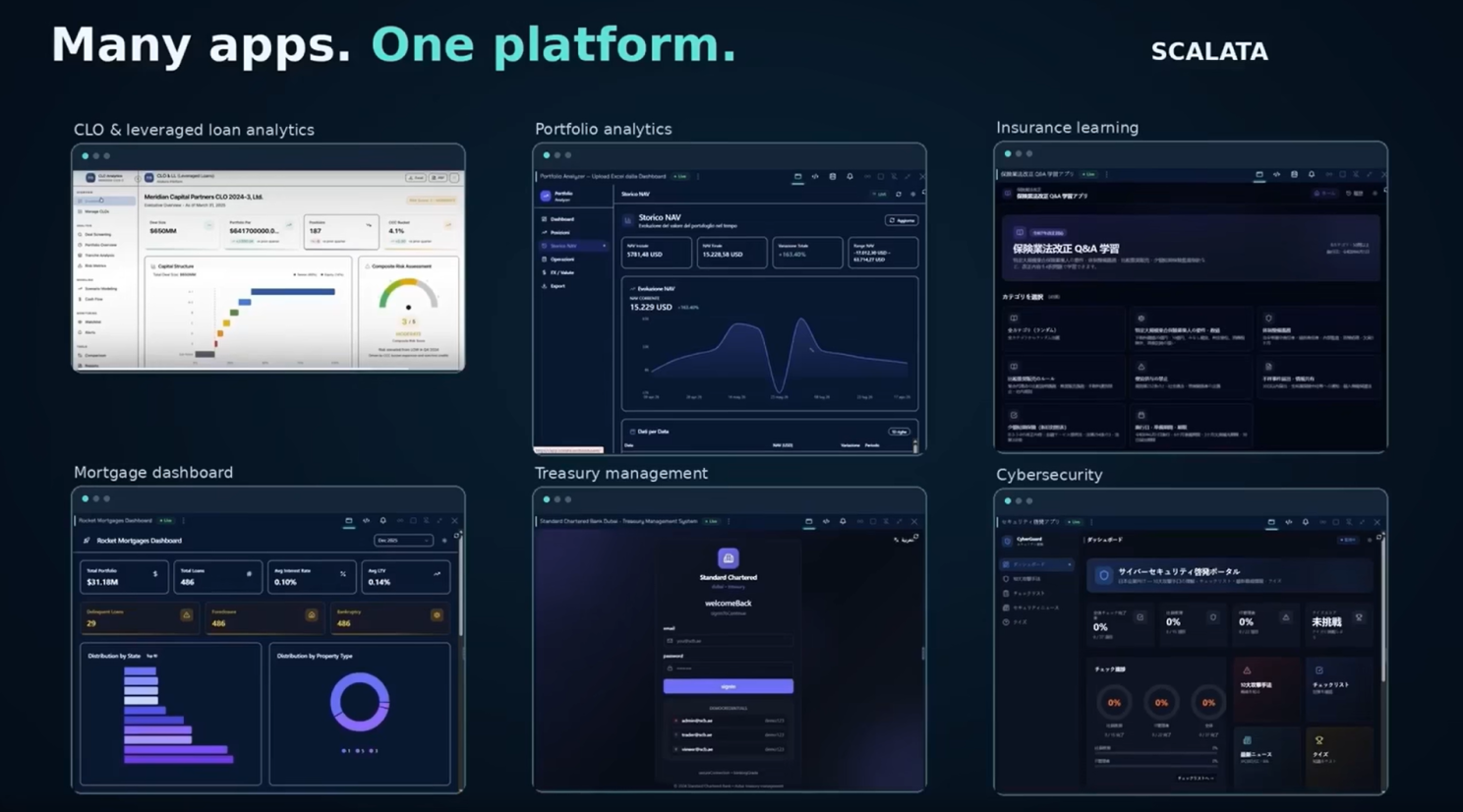
The tools above offer financial agents, structured research, or ready-to-review outputs. Scalata starts with what you want to build for your own process.
Scalata rejects this entirely.
With App AI, you can describe a custom app and generate a working starting point tailored to how you work.
 From Consumer to Creator
The 5-Minute Build
Think about what that actually means:
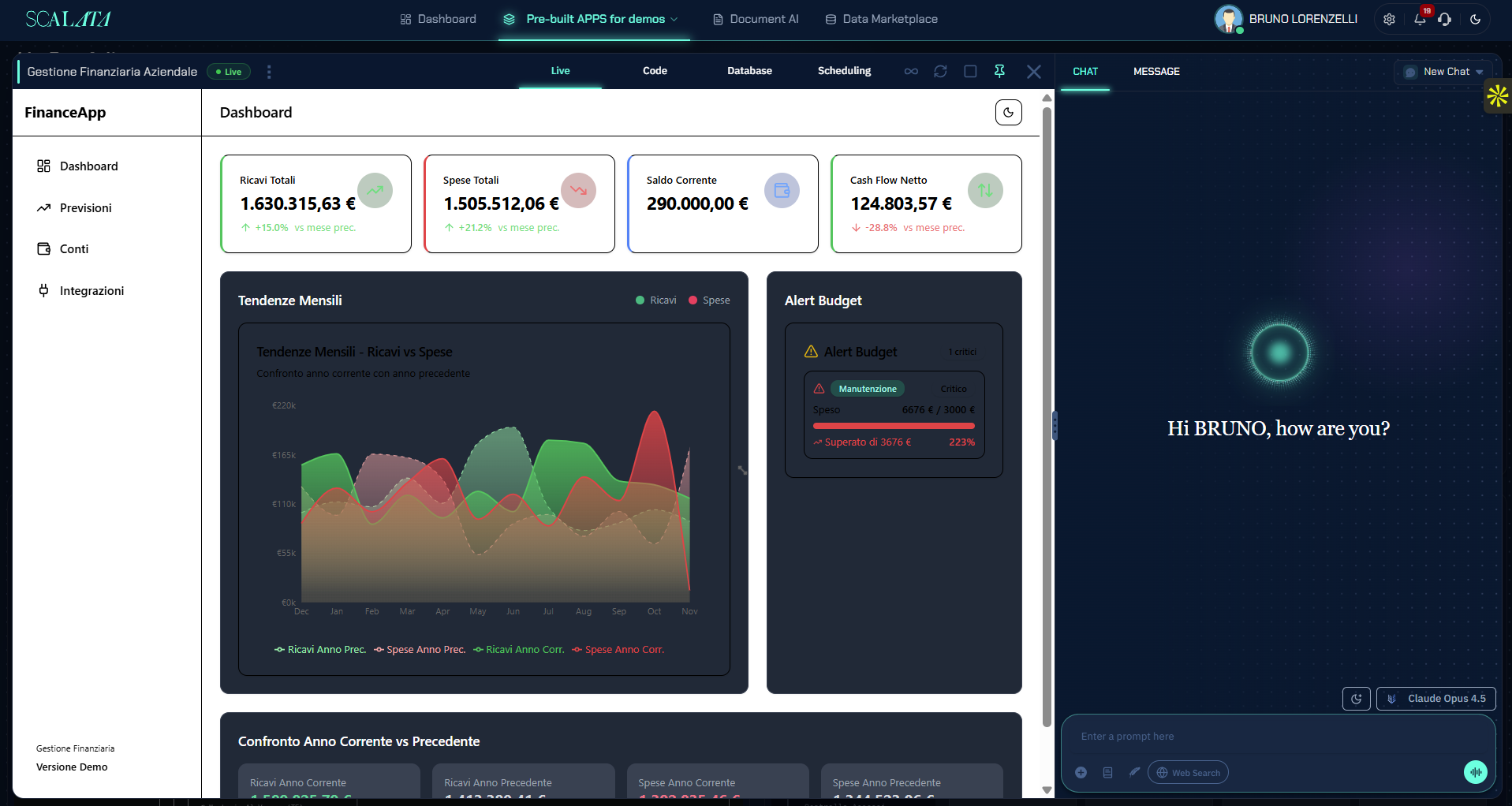
- Monday morning: You need a tool that monitors SEC filings for specific language patterns in risk disclosures. Build it.
- Tuesday afternoon: Your workflow requires a custom screener that combines fundamental data with sentiment analysis from earnings calls. Build it.
- Wednesday: You realize you need something entirely different — a document comparison tool that highlights changes between quarterly reports. Build it.
No waiting for Rogo to add it to their agent library. No hoping Hebbia's Matrix supports your use case. No submitting a feature request to AlphaSense's product team.
You can build an app around the task you already do.
 The 5-Minute Build
Personalization at the Individual Level
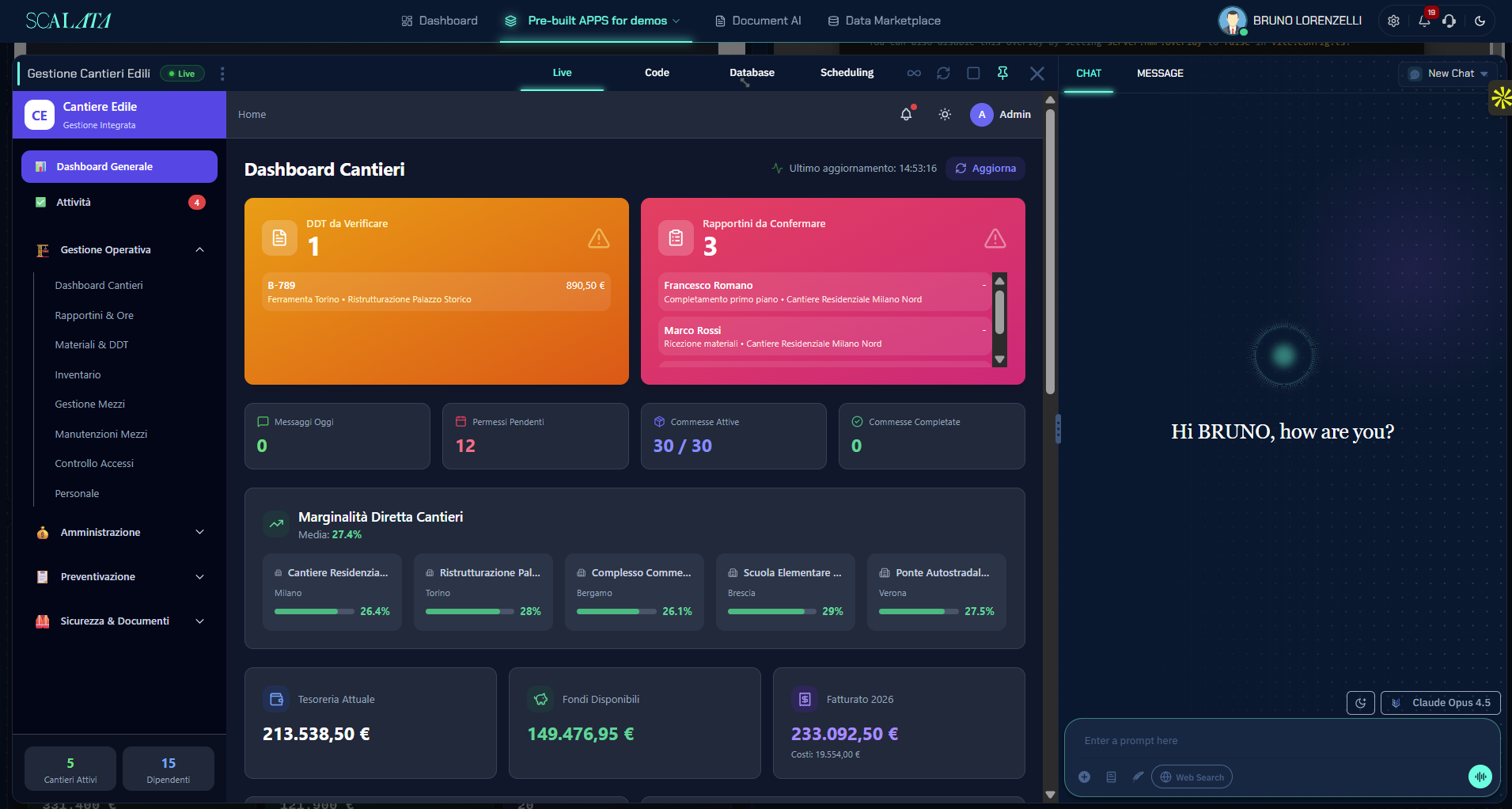
This is the fundamental difference: Scalata enables user-level personalization, not firm-level deployment.
| Competitor Approach | Scalata Approach |
|---|---|
| Financial agents for teams | Custom apps for individuals and teams |
| Structured research interfaces | Tools tailored to a specific workflow |
| Consume what's given | Create what's needed |
| Adapt yourself to the tool | Tool adapts to you |
When Auquan promises to convert "2 days → 30 min," they're still deciding what that workflow looks like. When Scalata gives you the building blocks, you decide.
 Personalization at the Individual Level
Tools That Evolve With Your Work
As a recurring task changes, you can update the tool built around it.
A change in reporting rules might mean revising a calculation, adding a review step, or changing what the app displays.
This isn't incremental improvement. This is a paradigm shift from AI consumption to AI creation. From accepting what you're given to building what you need.
8. Full Transparency: See the Models, See the Code
Here's the dirty secret the AI industry doesn't want you to think about: you have no idea what's actually happening behind the curtain.
A platform may support several models, as F2 describes, or organize results in a structured interface, as Hebbia does. For teams reviewing a workflow, a separate question is what they can inspect when they need to understand a result.
You're building critical workflows on foundations you can't inspect. That's not innovation — that's faith-based computing.
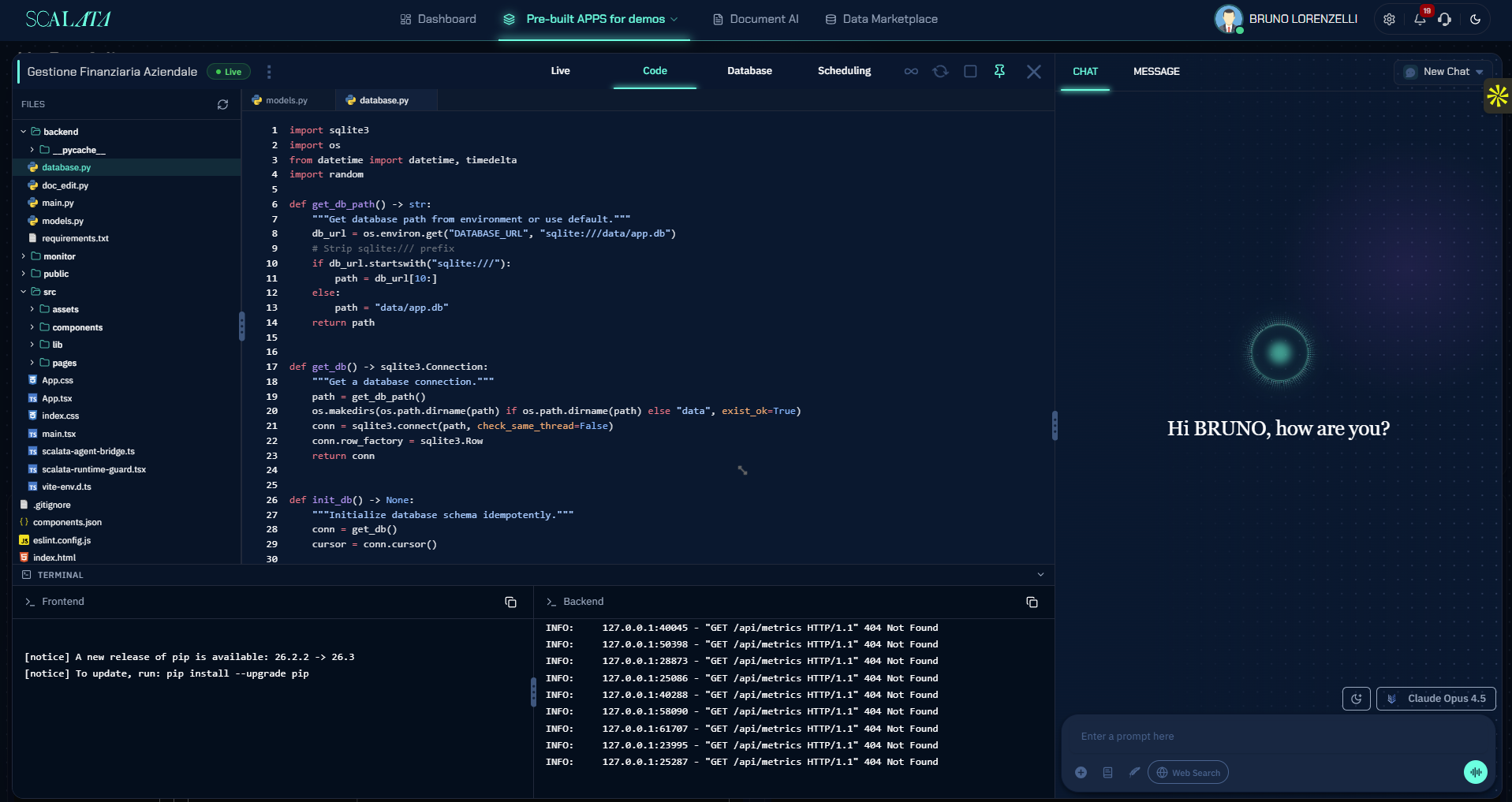 Full Transparency
No Hidden Models
Scalata operates on a fundamentally different principle: radical transparency.
Scalata lets organizations connect model endpoints and manage access and usage, giving teams visibility into which models are available for their work.
Why does this matter? Because when something goes wrong — and in high-stakes finance, understanding why is everything — you need to trace the logic. You need to debug. You need to improve. You can't optimize what you can't observe.
No Hidden Code
But model transparency is only half the equation. Scalata also shows you the underlying code.
Scalata makes generated code available alongside the outputs it produces. If a calculation looks unusual, you can review how the code handles the inputs and check whether it applies the rule you intended.
That gives a reviewer something concrete to check when an output changes or a calculation needs to be updated.
The competitors built black boxes and asked for your faith. Scalata built glass boxes and earned your confidence.
No hiding models. No hiding code. Just power through transparency.
Build AI tools around the way you work. See how Scalata brings custom apps, workflows, and your data together. Book a demo.