Perspective
One Agent, Many Sources
 One Agent, Many Sources
One Agent, Many Sources
Your data lives everywhere. Excel models from the FP&A team. Market feeds from Bloomberg and Reuters. PDF reports from portfolio companies. API connections to banking systems. CRM data from Salesforce. Document repositories in SharePoint. Each source holds a piece of the picture. Getting them to talk to each other? That's been the challenge for two decades.
The typical finance organization has data scattered across fifteen to twenty systems. Some are modern cloud platforms. Some are legacy systems that nobody dares touch. Some are spreadsheets that have become mission-critical despite everyone's best intentions.
Getting a complete picture—the kind of integrated view that actually supports decision-making—means pulling from all of them. Here's how that typically works, and how it could work instead.
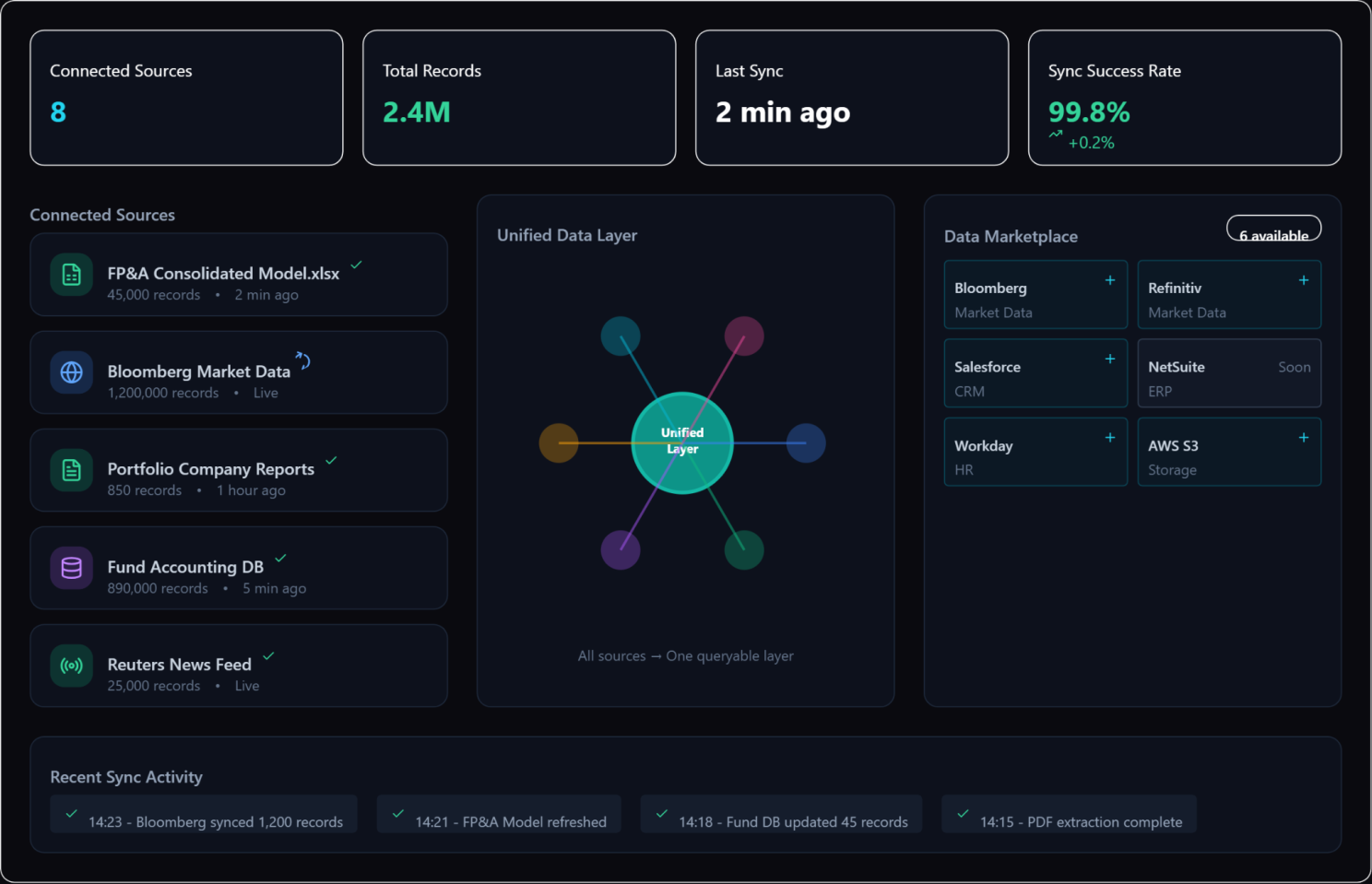 The Integration Landscape
The Integration Landscape: Then and Now
🔌 Integration effort
Then: Custom connectors, engineering time, and brittle systems.
Now: Plug in sources with Scalata ACT Connectors—no MCP servers or infrastructure changes.
⏱ Time to connect
Then: Weeks to months per source.
Now: Minutes to hours.
🔧 Maintenance
Then: Constant upkeep, with system upgrades breaking connections.
Now: Platform-managed connections and a marketplace of connectors.
🔍 Data access
Then: Query each source separately and reconcile manually.
Now: One unified layer. One query across all sources.
🔒 Security
Then: Different security models across connections, creating governance gaps.
Now: A governed data layer with consistent permissions.
📈 Scalability
Then: Every new source requires new development.
Now: Add sources without engineering involvement.
The difference is architectural. Traditional integration treats each connection as a separate project. Scalata treats integration as a platform capability.
How ACT Connectors Work
Scalata's approach is refreshingly simple: "Plug in your data sources—spreadsheets, APIs, PDFs and live feeds—through ACT connectors. No MCP servers to build, no infrastructure changes."
This isn't just faster integration—it's a different model entirely. Rather than building point-to-point connections between systems, ACT connectors create a unified data layer that all of Scalata's AI agents can access. Connect a source once, and every capability in the platform can use it.
The Data Marketplace extends this concept: "Your agents, connected to every source." Scalata's agents can "operate inside external clouds and databases in a secure and controlled way—without the need to implement server-side applications."
 ACT Connectors
The Twenty-Year Problem, Solved
As Scalata describes it: "For twenty years, integration has meant custom connectors, engineering time, and brittle systems. Scalata's Data Marketplace changes that by giving AI agents governed, intelligent access to the systems and data institutions already depend on."
This is worth unpacking. "Governed" means the same access controls apply regardless of source. "Intelligent" means the system understands the data structures, not just the bits. "Systems institutions already depend on" means you don't have to migrate to new platforms—you connect the ones you have.
Practical Application: Portfolio Monitoring
Consider a portfolio monitoring scenario at a private equity firm. The data you need lives in multiple places:
- NAV calculations in Excel models maintained by the fund accounting team
- Capital call and distribution notices as PDFs in the document repository
- Market valuations from an external pricing service API
- Investor communications and commitments in the CRM
- Portfolio company financials in various formats from various sources
Traditionally, pulling this together for a quarterly report means manual aggregation across all these sources. Someone downloads the NAV file, pulls the capital activity from the documents, looks up the market values, cross-references the CRM, and builds a consolidated view in yet another spreadsheet.
 Portfolio Monitoring
With ACT connectors, all these sources feed into a single queryable layer. You can ask: "Show me the performance attribution for Fund III, incorporating the latest market values and comparing to the capital called to date." The platform pulls from every relevant source, reconciles the data, and delivers a unified answer.
Security and Governance
Connecting more sources raises legitimate security concerns. If everything is accessible from one place, doesn't that create a single point of vulnerability?
 Security and Governance
Scalata addresses this through its governed data layer—the same compliance architecture that controls internal access extends to external connections. Enterprise customers get a marketplace of connectors with live widgets on every surface, all operating under the same role-based permissions and audit trails that govern internal data.
The principle is clear: "Your data, models, and workflows stay under your control—always." Connecting sources doesn't mean losing control of them.
Your data is scattered across a dozen systems. Your questions shouldn't have to be. One agent, many sources, one answer.